




Crowd, Database And Citizen: Protest And Preventive State
G.S. Bajpai & Chirag Balyan
22 Aug 2026 3:00 PM IST
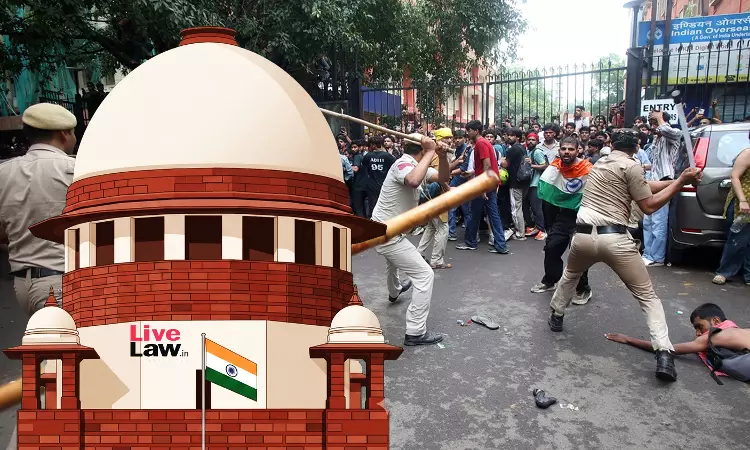
What the Jantar Mantar protests reveal about citizenship, protest and the preventive State
In a participative democracy, can the State treat protesters differently based on their criminal records, when nothing has been alleged about what they did at the protest itself? The events at Jantar Mantar in July 2026 force the question.
Delhi Police registered 13 FIRs in connection with NEET protests and the events that followed. While the protest was on, facial recognition vans identified 2,873 individuals in real time, 2,402 of them through the Crime-Kundli database and 471 through police dossier records, and of these, the police reported that 989 carried previous criminal records, including cases of murder, robbery, rape, and offences under the Arms Act and the narcotics law. The Supreme Court, in Shailendra Mani Tripathi v. Union of India (2026 SCC OnLine SC 1409), gave the States liberty on 28 July to proceed with investigation of the registered FIRs, while directing that no coercive measures be taken against protesting students, save those with criminal antecedents. On 3 August the Court clarified that criminal antecedents mean grave and heinous offences alone, and that the States remain at liberty to close or withdraw FIRs in accordance with law.
What an FIR sets in motion, and what the State cannot do with it
An FIR in a cognizable offence sets the criminal law in motion, and once it is registered the executive cannot simply undo it. The police must investigate and file a report, and even where that report seeks closure, the magistrate taking cognizance decides whether to accept it. An FIR may also be quashed, but only by the constitutional courts. A case may also end in discharge or acquittal. A prosecution may be withdrawn, but the prosecutor must move the court and the court must confirm.


So the police cannot close a case, nor can the State withdraw one on its own; judicial oversight is required. Why, then, should the executive be able to withhold relief from some protesters, before that scrutiny occurs, because of their criminal antecedents? That is what the State governments did, excluding them from the closure of cases, while the Supreme Court, on 28 July, withheld from the same category the protection against coercive measures it extended to other protesters. Nothing had been alleged about what these persons did at the protest. What separated them from the rest of the crowd was their prior record.
A prior record is not evidence of what happened at the protest.
The expression 'criminal antecedent' or 'prior record' may cover a pending FIR, a prosecution at any stage, a conviction, an acquittal, or a case closed long ago. A database entry does not distinguish among these. When the classification was applied, therefore, nobody knew which of these described the 989 persons identified, whether their cases were live or closed, or, if live, how far they had progressed. Nor can the label, by itself, serve as a basis for predicting that a person is dangerous, a hooligan, or must have offended at a particular protest.
Whatever the label records, it tells us nothing about what any of them did on 20 July. Criminal liability turns on conduct on the occasion in question, judged on the facts of that case. The general bad character of a person is irrelevant in criminal law, and the State's characterization that bad elements entered the protest with ulterior motives cuts against the fundamental premise that every individual is deemed rational and autonomous. To carry that reasoning further is to say that these persons have a propensity to offend and therefore no legitimate place in a public assembly, a conclusion that criminal law refuses, since even if some among them did commit transgressions at the protest, that could not justify withholding relief from all who carry a record, as each case falls to be decided on its own facts.
Preventive tools have a domain, and it ends when the assembly does
A criminal record is not always irrelevant. In preventive policing, antecedents have a recognized place because the inquiry is directed to apprehended harm. The State is permitted, within a prescribed legal framework, to draw an inference about future risk from past conduct. Security proceedings under the Bharatiya Nagarik Suraksha Sanhita and the relevant Police Acts therefore surround that inference with procedural constraints. The authority must identify the apprehension and the material on which it rests; the measure must bear a rational relation to necessity and proportionality; and the person concerned must have an opportunity to contest it. The predictive character of the exercise is thus accompanied by safeguards against its becoming conjectural or overbroad.
Criminal justice proceeds on a different footing. Its concern is not with the construction of a risk profile, but with attribution of responsibility for conduct alleged to have occurred. The difficulty arises when the inferential apparatus of prevention is imported into that inquiry without importing the conditions that make such inference legitimate.
Once the NEET protest was called off, there was no apprehended harm left to avert. The antecedents then acquired a different significance, becoming the basis for distinguishing those entitled to relief from those who would remain exposed to criminal process. The preventive rationale had lost its temporal and substantive connection with the occasion that had generated it, leaving behind differential treatment founded on past record rather than conduct at the protest. If someone's presence had breached the terms of his bail or bond, that was for the relevant court to consider; it could not, without more, justify treating him differently from the others.
The paradox of the responsible and the dangerous
Criminal law ordinarily treats the individual as responsible for his choices and answerable for what he does. Dangerousness introduces a different way of seeing that same individual. The State may continue to recognize him as a responsible citizen, entitled to vote and subject to the ordinary responsibilities of citizenship, while treating him as insufficiently trustworthy to participate in collective political action. The person remains a citizen, but his political agency becomes conditional on the State's assessment of his dangerousness.
This is the paradox in the exclusion. The same person whom the law holds responsible for his choices is treated, based on his past, as someone whose exercise of those choices cannot be trusted. Dangerousness thus does not merely identify a risk. It changes the terms on which the individual is permitted to exercise political citizenship. Once that happens, the State is no longer responding only to what the person has done. It is deciding what kind of political participant he is entitled to be.
The consequences of the label
The disclosure that 989 of those identified had previous criminal records inevitably affected how the assembly was perceived. It suggested that the protest was not merely a gathering of students pressing a grievance, but one in which criminal elements had become entangled. Whatever its effect on public perception, the significance of the disclosure extends to the conditions on which political citizenship is exercised. The right to assemble and protest is one of its most direct manifestations and, for those at the margins of social and economic life, often one of the few means of making a claim upon the State. Its underlying premise is that membership in the political community does not depend upon a prior assessment of one's worthiness to participate. When a criminal record becomes a basis for differentiating among citizens in the exercise of that freedom, political citizenship ceases to be experienced on equal terms.
The same distinction bears upon the trust that democratic life requires. We ordinarily regard the person beside us in a crowd as a responsible citizen unless his conduct gives us reason to think otherwise. To treat some citizens as less entitled to that confidence because of what appears in their criminal records places them under a different presumption from the outset. Their presence in a democratic assembly becomes something that requires explanation. At the same time, the label begins to shape how they are regarded by others and how they understand their own place in political life. This burden is likely to be most acute for those already exposed to closer policing and institutional suspicion. For them, the consequence may extend beyond a diminished willingness to protest to a diminished willingness to engage with the State itself.
What remains unresolved
The Supreme Court's clarification, confining criminal antecedents to grave and heinous offences and confirming that the States may close or withdraw FIRs in accordance with law, was a necessary correction. What still has to be settled is the standard that must govern any use of a record as a ground for treating citizens differently in the exercise of democratic rights, so that the preventive powers of the State operate where their conditions are satisfied and not as a substitute for the evidence that criminal law has always demanded. If the State can decide who deserves the ordinary presumption of citizenship by looking into his past, the question is no longer only what the citizen has done, but what kind of citizen the State is prepared to recognize.
Author G.S. Bajpai is a Vice-Chancellor at NLU Delhi & Chirag Balyan is an Associate Professor at DY Patil School of Law, Navi Mumbai. Views are personal.