



Termination Of Bank Employee Under Regulation Retrospectively Declared Unconstitutional Cannot Stand: Allahabad High Court
Upasna Agrawal
22 Aug 2026 4:00 PM IST
The Allahabad High Court has held that the termination of a bank employee under a regulation enacted after the Constitution of India but declared as unconstitutional, has retrospective effect and thus such termination cannot stand and would be illegal.
In doing so the court reiterated that the situation is different in case of a law enacted prior to the Constitution which is only eclipsed by its conflict with Part III and may be revived if the fundamental right it offended is amended or authoritatively read differently.
Quashing the 1983 termination of a Gramin Bank clerk, the Court held that the regulation on which it rested, struck down by the High Court in 1994, was void from its inception.
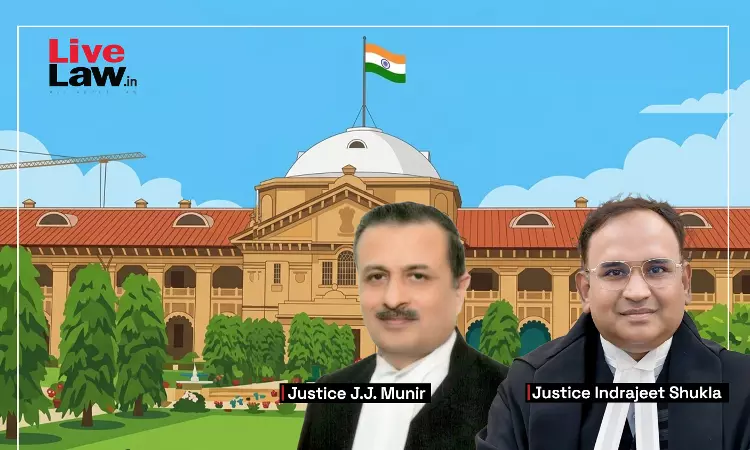
A division bench of Justice J.J. Munir and Justice Indrajeet Shukla held,
“If a statute, or for that matter a statutory regulation, is declared unconstitutional by a Court of law on ground that it offends Part III of the Constitution as in the present case, the pronouncement is declaratory, and, therefore, always retrospective. As soon as a law or statutory rule is declared unconstitutional and it happens to be a post-constitutional law, it is destroyed at birth and can never be imbued with life again, even if in the meantime some part of Part-III is amended or differently interpreted authoritatively.


In the present case, Regulation 10(2) before us is a regulation made in the year 1980. It is definitely a post-constitutional law within the meaning of Article 13 of the Constitution. Therefore, if this Court has declared it unconstitutional, apparently violative of Part-III, it is the end of the matter and the Regulations cannot be infused with life again. It is also not that it would be invalid inter partes and alive elsewhere between a different set of parties"
Appellant was appointed a Clerk with the Gorakhpur Kshetriya Gramin Bank on in 1981 on one year's probation and joined in July 1981. His probation was extended by six months by an order dated 20th July 1982. It was the Bank's case that his service was not found satisfactory, and it terminated him with immediate effect on 11th March 1983 under Regulation 10 of the Gorakhpur Kshetriya Gramin Bank (Staff) Service Regulations, 1980.
He sued in the same year for a declaration that the termination was illegal and that he continued in service. The suit was decreed in 1985, reversed in the Bank's first appeal and dismissed. His second appeal was dismissed on grounds that the termination was not contrary to the Regulations and holding that their vires could not be gone into by the civil court, while leaving him free to move under the Industrial Disputes Act or under Article 226.
The writ petition he then filed was dismissed by a Single Judge in 2004, giving rise to the present appeal. Observing that the Single Judge had disposed of the matter briefly despite elaborate arguments, and a remand would ordinarily have been fitting but was not open after so many years, the Court decided the writ petition on merits itself.
On the first question, whether continuance beyond the maximum period of probation results in confirmation, the Court held that the answer turns on the language of the applicable rule. Regulation 8(2) placed an employee on probation for a year, extendable by not more than six months, and Regulation 9 provided for confirmation where the appointing authority was of opinion that probation had been satisfactorily completed.
Finding the Regulations pari materia with the Gurgaon Gramin Bank (Staff) Services Regulations, 1980, the Court applied M.K. Agarwal v. Gurgaon Gramin Bank, where the Supreme Court held that a ceiling on the employer's power to extend probation, coupled with the requirement that the probationer be confirmed or discharged at the end of it, made confirmation by implication inescapable where no discharge was ordered.
“The result is that it must be held that after the extended period of probation came to end for the appellant on 19.01.1983, he would be deemed to have been confirmed in service, and, a fortiori, a permanent employee when the impugned order of termination dated 11.03.1983 was passed.”
Further, the Court noted that Regulation 10(2)(a) had already been declared unconstitutional by the High Court in Rudra Kumar Pal v. Chairman, Gorakhpur Kshetria Gramin Bank, decided on 1st December 1994 in a matter to which the Bank's predecessor was a party, following M.K. Agarwal, where the Supreme Court had held the identically worded Gurgaon clause to confer arbitrary and unguided power.
Counsel for the Bank argued that a point bearing on the case had passed sub silentio in Rudra Kumar Pal. The Court held that this could at most affect that judgment's value as a binding precedent.
“A declaration, that a particular statutory regulation is unconstitutional, made by this Court, operates in rem somuch so that as far as this Court is concerned, we cannot bring it back to life, even if we were to hold a different opinion on any ground, including that the point involved, that would have bearing on the case, passed sub silentio in that judgment.”
It was further submitted that the declaration in M.K. Agarwal came on 20th November 1987 and that in Rudra Kumar Pal on 1st December 1994, so that neither could touch an order passed on 11th March 1983. The Court rejected this, holding that M.K. Agarwal did not of its own force invalidate the Gorakhpur Regulations, and that the declaration in Rudra Kumar Pal, striking down a regulation framed in 1980 for offending Part III, was declaratory and so retrospective.
Relying on the Constitution Bench decision in Central Bureau of Investigation v. R.R. Kishore, it observed that nothing showed the declaration to have been made prospectively or to have been hedged in by any temporal limitation.
“The rule, under which the Bank have acted to terminate the appellant's services, as a perusal of the impugned order would show, having been held unconstitutional by this Court, there is nothing that can save the order impugned from perishing.”
The Court observed that the appellant would now be aged about 70 years and could not be reinstated. It noted that he had pursued his remedies diligently but for the last stage, and had worked for a negligible period while remaining out of the Bank's employ for most of his life, through no fault of his own.
Referring to Constable Uma Shankaran v. Union of India, where the Supreme Court held that though back wages are not automatic, an employee kept from work by the employer's illegal act has a legitimate claim to what he would have earned, the Court held that full back wages would normally follow, but that here 50% back-wages with all consequential benefits would meet the ends of justice.
Allowing the appeal with costs of Rs. 10,000/-, the Court set aside the order of the Single Judge, allowed the writ petition and quashed the termination order dated 11th March 1983. A mandamus was issued to the Chairman, General Manager and Branch Manager, Uttar Pradesh Gramin Bank to pay 50% back-wages from the date of termination until superannuation, with post-retiral benefits due, within one month of receipt of a copy of the judgment.
Case Title: Sachindra Kumar Pandey v. Gorakhpur Kshetriya Gramin Bank and others
Counsel for the Appellant :- K. Shahi
Counsel for the Respondents :- Aditya Kumar Singh, Ashok Khare