



Allahabad High Court Strikes Down Key Provisions Of UP's 2021 Tenancy Act; 1972 Rent Law Revives To Extent Required
LIVELAW NEWS NETWORK
24 Aug 2026 3:32 PM IST
In a significant judgment, the Allahabad High Court on Friday struck down key provisions of the UP Regulation of Urban Premises Tenancy Act, 2021, holding that its provisions on rent revision, rent determination and eviction are repugnant to existing Parliamentary law.
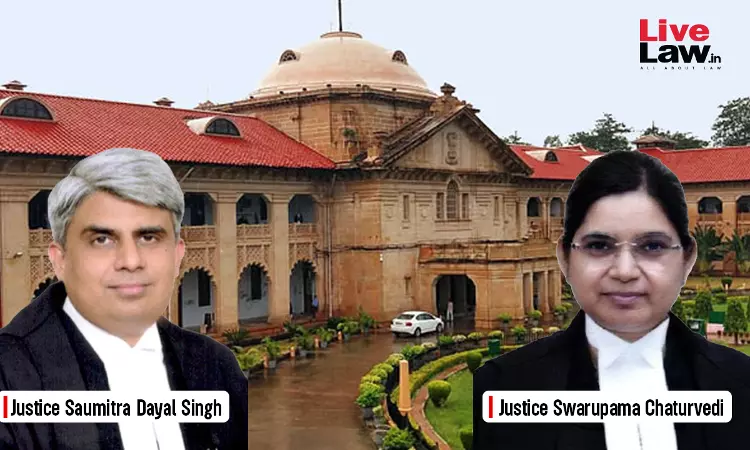
A Bench of Justice Saumitra Dayal Singh and Justice Swarupama Chaturvedi held that Sections 8, 9 and 10 of the 2021 Act, along with provisions providing for eviction by order of the Rent Authority, are repugnant to the Transfer of Property Act, 1882 (TPA).
The Court separately declared Sections 38 and 42 of the Act as ultra vires to the extent that they seek to override the established procedure under the Provincial Small Causes Court Act, 1887 (SCC Act) read with the U.P. Civil Laws (Amendment) Act, 1972, without prior Presidential assent.
Importantly, the Court clarified that it was not striking down the entire 2021 Act. It applied the doctrine of severability to strike down only those provisions which were found to be directly in conflict with the constitutional scheme and existing Parliamentary laws.


The judgment was delivered on a batch of 16 petitions challenging the validity of the 2021 Act, Sections 9 and 10, as well as various orders and proceedings undertaken by Rent Authorities, including rent determination, execution and eviction proceedings.
One of the main challenges made in the petitions was that the State Legislature lacked competence to enact the 2021 Act without Presidential assent under Article 254(2).
Dealing with this argument, the High Court held that laws governing the relationship between landlords and tenants, with respect to house accommodation or buildings, fall within Entry 6 of List III (Concurrent List) of the Seventh Schedule. In this regard, the Court relief particularly on the Supreme Court's decision in Indu Bhushan Bose v. Rama Sundari Devi.
The Bench held that Indu Bhushan Bose remains the direct authority on legislative competence and that the State's competence is traceable to Entry 6 of List III (Concurrent List), rather than Entry 18 of List II (also known as the State List).
Consequently, the Court proceeded to examine whether the 2021 Act was repugnant to the TPA and the SCC Act read with the Civil Laws Act and whether the absence of Presidential assent rendered the conflicting provisions unenforceable.
The Bench clarified that the mere enactment of a special tenancy law would not by itself create repugnancy; the question was whether the two laws could operate simultaneously without conflict.
The Court found that Chapter III of the 2021 Act created rights and liabilities concerning rent that were materially different from those under the TPA.
It noted that while the parties could agree on rent under the lease, the TPA contained no provision permitting a lessor to increase rent or have it determined outside the contractual terms.
By contrast, Sections 8, 9 and 10 of the 2021 Act provided mechanisms for revision and determination of rent, including determination by the Rent Authority in the event of a dispute.
The Court therefore observed thus:
"As to the rent payable, Section 8 allows that revision of the same in terms of Section 9 and for its determination in terms of Section 10. First, revision may arise in terms of the tenancy agreement as may also the case under TPA, but then provisions exist under the Impugned Act to provide for upward revision of the rent at specified rates. Also, Section 10 provides for determination of revised rent in the case of the dispute between the landlord and the tenant i.e. lessor and lessee that is completely in conflict with the provisions of TPA".
The Bench found that the 2021 Act introduced statutory grounds for eviction that went beyond the rights and liabilities arising from the parties' lease itself.
These included eviction on grounds such as non-payment of rent, repairs or reconstruction, rebuilding after a change of land use, failure to vacate after notice, unauthorized alterations and the landlord's requirement for self-occupation.
The Act also granted the legal heirs of a deceased landlord statutory rights to seek eviction on the ground of personal need, along with a penal-rent provision in specified circumstances.
The Court contrasted this with Section 111 of the TPA, which sets out the modes by which a lease is determined, including efflux of time, fulfilment of conditions, surrender and forfeiture.
It concluded thus:
"Determination of lease is governed by Section 111 of the TPA. It speaks of efflux of time; fulfillment of condition; rights being getting vested in a third party; express surrender; implied surrender; forfeiture and expiration of needs to determine the lease. Those being the only modes to determine the lease, provisions of the Impugned Act, are not reconcilable with the same, on their own. To that extent, repugnancy exists".
The Court also found procedural conflict in the 2021 Act's creation of a separate mechanism for the resolution of landlord-tenant disputes through the Rent Authority and Rent Tribunal.
It noted that the Act, read with Sections 38 and 42, created a “special forum” contrary to the procedure prescribed under the SCC Act read with the Civil Laws Act.
It also noted that the 2021 Act contemplates negotiable disputes and creates a Rent Tribunal, which also creates a clear repugnancy with the SCC Act read with the Civil Laws Act.
The Court held that, in the absence of Presidential assent, the State law could not override the Parliamentary law and the Civil Laws Act, which had received the assent of the President. It was further observed thus:
"The Impugned Act seeks to override TPA as also the SCC Act read with Civil Laws Act, which laws are referable to List III of the Seventh Schedule to the Constitution of India, clearly that effect in law may arise only through the route of Presidential assent In absence of that essential constitutional requirement being fulfilled, the Impugned Act to the extent it is repugnant to the laws made by the Parliament must remain unenforceable".
Accordingly, Sections 38 and 42 were declared ultra vires to the extent that they sought to override the established SCC Act procedure, read with the Civil Laws Act, without prior Presidential assent.
The Court, however, clarified that there would be no legal vacuum due to the striking down of the 2021 Provisions, as the earlier U.P. Urban Buildings (Regulation of Letting, Rent and Eviction) Act, 1972, which had been repealed by Section 46 of the 2021 Act, would spring back to life, of its own to the extent required.
Thus, the judgment does not revive the 1972 Act wholesale in every respect; the Court specifically said it would spring back “to the extent required.”
Consequently, the Court declared Sections 8, 9, 10, 38 and 42 ultra vires "from today".
At the same time, it protected matters and proceedings already concluded where no challenge to the validity of the provisions had been raised.
This expressly includes rent agreements executed and rent revised or determined under the 2021 Act in such concluded matters. The Court said those revised terms would continue to govern the substantive rights of the parties and would remain enforceable under the repealed Act, TPA read with the SCC Act and Civil Laws Act, as applicable.
However, the individual orders challenged in the 16 writ petitions were quashed. The writ petitions were accordingly allowed
Case title - Inder Bhushan Sawhney vs. Kanchan Kumari Jain (Dead) and 2 Other 2026 LiveLaw (AB) 615 and connected matters
Case Citation: 2026 LiveLaw (AB) 615