



S.362 CrPC Applies To S.138 NI Act Proceedings; Magistrate Can Recall Non-Final Orders To Ensure Fair Trial: J&K&L High Court
LIVELAW NEWS NETWORK
24 Aug 2026 4:40 PM IST
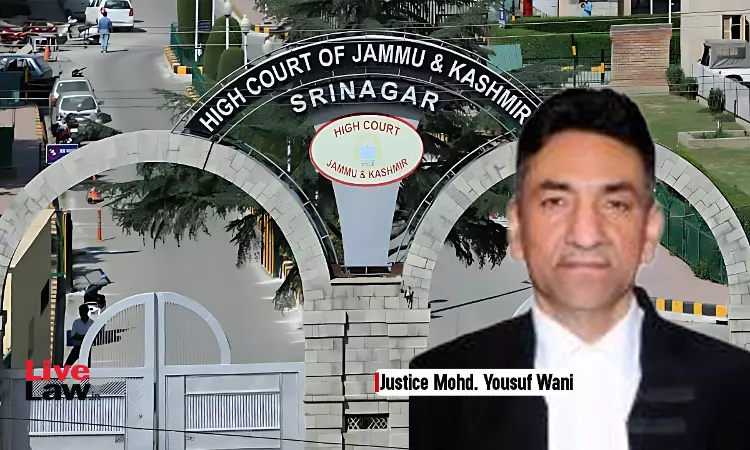
The High Court of Jammu & Kashmir and Ladakh has held that the provisions of Sections 362 and 311 of the Code of Criminal Procedure, 1973, cannot be said to be inapplicable to the proceedings of a complaint initiated under Section 138 of the Negotiable Instruments Act, 1881.
The Court observed that since most of the sections of Chapter XVII of the NI Act start with a non-obstante clause, they apply to proceedings under Section 138 despite anything contrary in the CrPC, meaning the provisions of the CrPC are not inapplicable in respect of other matters of procedure.
The Court was hearing a petition filed under Section 528 of the Bharatiya Nagarik Suraksha Sanhita, 2023 (BNSS), seeking quashing of orders passed by the Judicial Magistrate (Sub-Judge/Special Mobile Magistrate), Baramulla, whereby the Magistrate closed the evidence of the complainant and dismissed his application seeking recalling/revisit of the earlier order.
A Bench of Justice Mohd Yousuf Wani, while allowing the petition, observed,


"The provisions of Sections 362 and 311 of the Code cannot be said to be inapplicable to the proceedings of a complaint initiated under Section 138 of the NI Act because most of the sections of Chapter XVII of the Negotiable Instruments Act, 1881, viz., Sections 142, 142(a), 143, 143(a), 144, 145, 147, and 148, start with a non-obstante clause, i.e., 'notwithstanding anything' meaning thereby that the said provisions apply to the proceedings of a complaint filed under Section 138 of the NI Act…. It, at the same time, also means and conveys that the provisions of the Code are not inapplicable in respect of other matters of procedure arising out of a complaint under Section 138 of the NI Act."
The Court further observed,
"Courts are respected not for legalizing injustice, but for removing the same. The passing of the impugned orders has led to the filing of the instant petition under Section 528 of BNSS, in which, at the first hearing on 7-2-2025, the basic impugned order dated 26-7-2023 came to be stayed. The orders passed in a casual, hot haste, and cavalier manner, actually delay the proceedings as a consequence thereof."
Background:
The petitioner filed a complaint under Section 138 of the Negotiable Instruments Act against the respondent, which was assigned for disposal to the Trial Magistrate. Subsequently, the COVID-19 infection stopped routine life activities, affecting normal court proceedings. The petitioner's counsel got appointed as a Prosecuting Officer, whereafter his case came to be handled by Junior.
The petitioner contended that the Junior Advocate did not update him about the proceedings and, for lack of proper experience, did not deal with his case properly, resulting in the closure of evidence. The petitioner further contended that the fact of closure of evidence was not even intimated to him, and he knew about the same when the advocate returned the brief of the case on the ground of her marriage. The petitioner was not present in the court when the evidence in the complaint was closed.
Thereafter, the petitioner filed an application before the Trial Magistrate seeking recalling/revisit of the earlier order for recording the statements of two important witnesses, namely, the concerned Bank Manager and the Postman, who were required to be summoned through the trial court. The Trial Magistrate, through the second impugned order dismissed his application.
Court's Observation:
The Court examined the impugned orders and found that the Trial Magistrate had closed the evidence of the complainant when the complainant was absent but his counsel was present, and no witness was present on that day. The Court noted that prior to the order, there was representation on the part of the complainant on consecutive preceding hearings.
The Court observed,
"The Ld. Trial Magistrate ought to have passed an alarming order prior to the closure of the evidence of the complainant-petitioner by directing for production of the entire evidence with the stipulation that in case of failure, the court can close the evidence for paving a way for expeditious trial of the case, which appears to have not been done."
The Court accepted the petitioner's explanation for the delay, noting that on one hand, the COVID-19 pandemic spell intervened during the proceedings of the complaint, and secondly, the counsel representing him got appointed as a Prosecuting Officer, which led to his case being handled by a junior advocate, who also handed over the brief on account of her marriage. The Court observed,
"It has however inter alia been averred by the petitioner-complainant in his petition that he was prevented from producing his entire evidence, especially the two material witnesses needed to prove his complaint, due to the intervening Covid-19 pandemic and also because the counsel engaged by him could not conduct the proceedings properly."
On the applicability of CrPC provisions, the Court held that Sections 362 and 311 of the Code are applicable to proceedings under Section 138 of the NI Act. The Court observed,
"The Ld. Trial Magistrate has declined to recall its earlier order dated 26.7.2023 on the ground that the complaint was filed on 14.2.2020 and the complainant's evidence was directed to be produced vide order dated 12.10.2021. That the petitioner-complainant did not produce the entire evidence despite innumerable opportunities till 26.7.2023."
The Court held that the Trial Magistrate's observation that there is no provision in the Code giving him the power to recall his own orders is not justified. The Court observed,
"The contention of the Ld. Magistrate, that there is no provision in the Code giving him the power to recall his own orders, does not appear to be justified because the provisions of Section 362 of the Code corresponding to Section 403 of BNSS authorizes a criminal court to alter or review its orders which are not final and dispose of the case. The Ld. Magistrate could have exercised his powers under Section 362 of the Code to recall the order dated 26-7-2023, as there were justified grounds warranting the same."
The Court also observed that the provisions of Section 311 of the Code corresponding to Section 348 of BNSS lay down the power of a criminal court to be exercised at any stage of inquiry, trial or other proceeding for summoning any person as a witness or to examine any person in attendance, if his evidence appears to the court to be essential to the just decision of the case.
"The highest thing that could have happened if the Ld. Magistrate would have allowed the application of the complainant-petitioner, for recalling of the earlier closure order, is that the petitioner-complainant would have been in a position to get his two material witnesses examined in the proceedings of the complaint, which would have, in turn, facilitated a fair, transparent, and just decision of the case.", Justice Wani remarked.
In consonance with these observations the court allowed the petition, set aside the impugned orders and directed the Trial Magistrate to allow the petitioner-complainant to produce and examine his two material witnesses, namely, the Bank Manager and the Postman concerned.
Case Title: Abdul Hamid Bhat v. Abdul Rashid Bhat
Citation: 2026 LiveLaw (JKL)
Appearances
Petitioner: Mr. Bashir Ahmad Zargar, Advocate
Respondent: Mr. N.H. Shah, Sr. Advocate; Ms. Suwaiba, Advocate