




Defective Summary Suit Need Not Become Dead Suit; Underlying Claim Can Be Preserved As Ordinary Recovery Action: J&K&L High Court
LIVELAW NEWS NETWORK
25 Aug 2026 1:50 PM IST
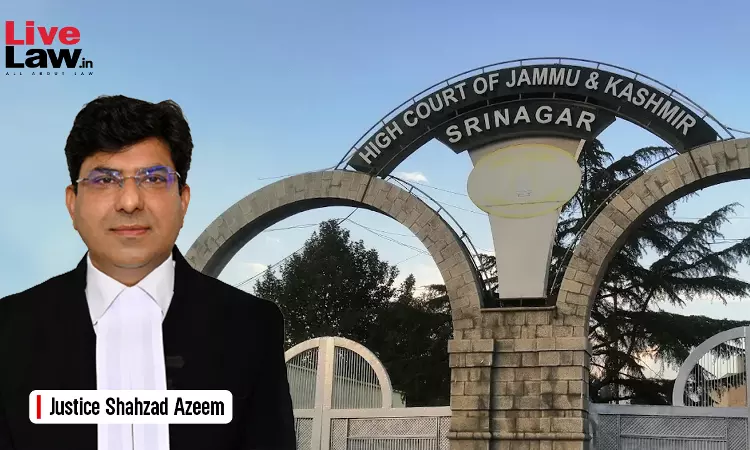
The High Court of Jammu & Kashmir and Ladakh has held that a defective summary suit need not meet a dead end as een where the requirements of Order XXXVII of the Code of Civil Procedure, 1908 are not fulfilled, the Court can treat the suit as an ordinary civil suit and proceed with it in accordance with law.
The Court observed that the failure to satisfy the conditions of a summary suit does not warrant dismissal where the plaint otherwise discloses an underlying debt and the defendant's refusal to repay it.
The Court was hearing a Civil First Appeal directed against the judgment and decree passed by the learned Additional District Judge, Budgam, whereby the plaint was rejected under Order 7 Rule 11 of the CPC on the ground that the suit based on a stale and unrepresented cheque was not maintainable under Order XXXVII CPC.
A Bench of Justice Shahzad Azeem, while allowing the appeal, observed,
"Even if the finding of the Trial Court that the suit is not maintainable under Order XXXVII is accepted, the appropriate course was to convert the suit into an ordinary money recovery suit rather than to reject the plaint outright. The plaint clearly discloses: (i) Advancement of a loan of ₹5.00 lakh; (ii) Issuance of a cheque of ₹4.00 lakh by way of part payment/acknowledgment of the debt; and (iii) Subsequent refusal by the respondent to repay the amount. These averments constitute a complete cause of action for a regular suit for recovery of money."


The Court further remarked,
"Rejection of the plaint extinguishes the claim and forces the plaintiff to institute a fresh suit subject to limitation. Conversion preserves the suit and enables adjudication on merits."
Background:
The case arose from an alleged transaction whereby the appellant extended a friendly loan of ₹5.00 lakhs to the respondent for the performance of Hajj by his father. In discharge of the liability, the respondent issued a cheque for ₹4.00 lakhs in December 2024 with a promise to pay the balance ₹1.00 lakh in cash.
The respondent, through the intervention of respectable persons, requested the appellant not to present the cheque for encashment and assured payment in cash. The appellant, trusting the assurance, did not present the cheque. Consequently, the cheque expired and the respondent thereafter refused to repay the amount.
Left with no other option, the appellant filed a suit under Order XXXVII of CPC for recovery of ₹4.00 lakhs. The respondent filed an application seeking leave to defend. Before the application for leave to defend could be considered, the respondent raised an objection to the maintainability of the suit on the ground that the suit was based on a stale and unrepresented cheque and, therefore, did not disclose any cause of action.
The Trial Court held that the cheque was never presented to the banker, a fact admitted by the appellant, and that once the cheque was not presented, no cause of action arose for maintaining a suit under Order XXXVII CPC. Accordingly, the plaint was rejected under Order 7 Rule 11 of CPC.
Court's Observation
The court examined the Trial Court's findings and noted that there could be no quarrel with the legal proposition that a suit under Order XXXVII CPC based on a cheque is maintainable only when the cheque has been presented and dishonored. The Court observed,
"There can be no quarrel with the legal proposition that a suit under Order XXXVII CPC based on a cheque is maintainable only when the cheque has been presented and dishonored. The Trial Court has correctly followed the law laid down by this Court in Rajesh Madanlal Anand (supra) on this aspect."
However, the Court found that the Trial Court, while rejecting the plaint, overlooked the fact that the plaint read as a whole disclosed a complete cause of action for a regular money recovery suit on the underlying loan transaction, the issuance of the cheque as an acknowledgement of debt, and the subsequent refusal to repay.
The Court observed,
"It is well settled that where a civil wrong is alleged, the court should ordinarily not leave the aggrieved party remediless, especially when the plaint discloses a cause of action for an ordinary suit. Rejection of suit under Order 7 Rule 11 of CPC in such circumstances is a drastic course and should be resorted only when no cause of action whatsoever is disclosed."
The Court held that once the respondent had appeared and filed an application for leave to defend raising serious triable issues, including partnership, a counter claim of ₹24.76 lakh, and allegation of forgery of signature, the Trial Court ought to have held that the suit was not maintainable under Order XXXVII CPC and directed that same be tried as an ordinary suit, instead of rejecting the plaint.
The Court clarified the applicability of Order XXXVII CPC, observing,
"From a plain reading of Order XXXVII CPC, it is discernible that the special procedure is available only upon fulfilment of prescribed conditions. Where the conditions are not satisfied or where defendant raised triable issues, the court is not precluded from treating the suit as an ordinary suit and proceeding accordingly."
In view of these conclusions the Court allowed the appeal, set aside the judgment and decree of the Trial Court, and directed that the suit shall be tried as an ordinary money recovery suit.
Case Title: Sheikh Ghulam Hassan v. Mohammad Amin Dar
Citation: 2026 LiveLaw (JKL) 326
Appearances
Appellant: Mr. Wajid Mohammad Haseeb, Advocate
Respondent: Mr. Mohd. Ibrahim Wani, Advocate