



Scribe Can Also Be Attesting Witness To Will, But Must Intend To Attest It: Punjab & Haryana High Court
Aiman J. Chishti
24 Aug 2026 6:45 PM IST
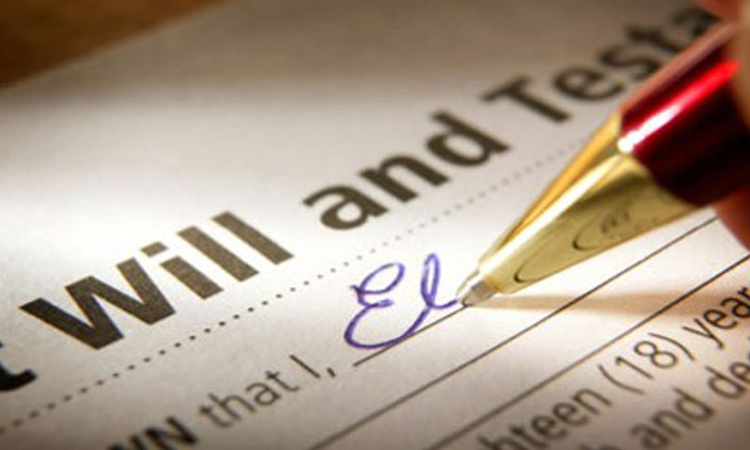
The Punjab and Haryana High Court has held that there is no legal requirement disqualifying a scribe from also being an attesting witness to a Will, so long as the intention to attest, the animus attestandi, is established. [2026 LiveLaw (PH) 291]
Justice Vikas Suri said that "there is no bar for person to be a scribe as well as an attesting witness," clarifying that what the law forbids is "treating" a scribe as an attesting witness, not a person who is genuinely both.
"A conjoint reading of Section 63 of the Succession Act and Section 68 of the Evidence Act would show that the purpose for which a Will is attested by a witness, is distinctly defined. An attesting witness would attest the Will on the request made by the testator for the purpose of due execution of the Will and in accordance with the mandate of Section 63 of the Succession Act. Thus, it has to come in evidence that the attesting witness had the intention to attest, i.e. the animus attestandi. It is in such circumstances that a scribe, who has though appended his signatures to the testamentary disposition, cannot be treated to be an attesting witness unless he had the aforesaid intention of being an attesting witness," the bench explained.


However, there is no bar for the said person to be a scribe as well as an attesting witness, it added.
The suit giving rise to the appeal was filed by Harbhajan Kaur, an issueless widow, for possession of a house in Basti Jodhewal, Ludhiana, against her sister Amarjit Kaur, Amarjit's husband, and their children.
Harbhajan Kaur's case was that she had earlier executed a Will in favour of Amarjit Kaur, but on discovering that Amarjit's intentions had turned dishonest, revoked it by a registered Revocation Deed in 2008. Amarjit Kaur thereafter allegedly tried to claim the house on the strength of a forged agreement to sell, filing a civil suit that was dismissed in default in 2009.
After the death of Harbhajan Kaur's brother, who had been caring for her, the defendants allegedly took forcible possession of the house in January 2010 while she was away, along with her household goods and the original title documents, and refused to vacate despite her demand.
During the pendency of the suit, Harbhajan Kaur died, and Gurwinder Kaur–the biological daughter of Amarjit Kaur but claimed to have been adopted by Harbhajan Kaur–was impleaded as Harbhajan's legal representative on the strength of a registered Will dated 15.03.2013 executed in her favour by the deceased.
Harbhajan Kaur's ownership was undisputed, admitted even by Amarjit Kaur; the agreement to sell relied upon by Amarjit Kaur was never proved and the original never produced; and an agreement to sell does not by itself confer title. The suit for possession and permanent injunction was decreed, though mandatory injunction for the household goods was refused for want of proof of ownership. These concurrent findings on title were not challenged before the High Court.
Succession Act Argument Rejected
Before the High Court, the appellants argued that since the property belonged to a female Hindu, the general rules of succession under Section 15 of the Hindu Succession Act, 1956 applied, requiring distribution among heirs under Section 16.
The Court rejected this at the threshold. Section 15(1) applies only where two conditions are met — the property belongs to a female Hindu, and she dies intestate. Since Harbhajan Kaur had executed a registered Will which stood proved, succession was governed instead by Section 30 of the Act, which permits testamentary disposition by any Hindu in accordance with the Indian Succession Act, 1925.
Scribe can be Attesting Witness to will
The appellants' remaining challenge was that one person cannot be both scribe and attesting witness to a Will.
The Court held "no longer res integra", relying on the Supreme Court's decision in Mathew Oommen v. Suseela Mathew, (2006) where it was held that there is no requirement in law that a scribe cannot be an attesting witness, so long as the person's intention to attest is clear from the record.
The Court distinguished the settled principle that a scribe cannot be treated as an attesting witness merely by having written the document, the present case, it held, was different: one of the two attesting witnesses had also signed as scribe, which is permissible provided his animus attestandi is shown.
It further examined that Section 63 of the Indian Succession Act, requiring an unprivileged Will to be attested by two or more witnesses, each of whom must have seen the testator sign (or receive acknowledgment of the signature) and must sign the Will in the testator's presence and Section 68 of the Evidence Act (now Section 67 of the Bharatiya Sakshya Adhiniyam, 2023), requiring at least one attesting witness to be examined to prove execution.
Relying further on N. Kamalam v. Ayyasamy, (2001), the Court reiterated that attestation requires two things: that the attestor witnessed execution of the Will, implying presence, and that he certified execution by subscribing his name with conscious intention to attest.
In the present case, the Will dated 15.03.2013 in favour of Gurwinder Kaur was a registered document, and one of its attesting witnesses, S.L. Mahey, Advocate, was examined and deposed clearly in its favour.
It was conceded that he had signed both as scribe and as attesting witness. The Court held that his statement that the Will had already been prepared before the testator came to him did not, by itself, disprove his role as attesting witness or the genuineness of his dual signature. Despite lengthy cross-examination, nothing was elicited to cast doubt on his credibility.
Hence, the second appeal was accordingly dismissed as devoid of merit.
Title: Amarjit Kaur and others v. Harbhajan Kaur @ Bhajan Kaur through her LR
Appearances: Mr. M.S. Dalal and Mr. Himanshu Kashyap, Advocates for the appellants.