




NFSU–TSUL Invite Applications For Dual Degree LL.M In Cyber Crime Law & Digital Forensics (2026–27)
Law School Correspondent
21 Aug 2026 4:39 PM IST
The National Forensic Sciences University (NFSU) was established in 2009 as Gujarat Forensic Sciences University under the visionary leadership of the Hon'ble Prime Minister of India, Shri Narendra Modi, who was then the Chief Minister of Gujarat. In 2020, the University was elevated to the status of a Central University through an Act of Parliament and designated as an Institution of National Importance under the Ministry of Home Affairs, Government of India.
NFSU is the world's first and only university dedicated to education, training, research and innovation in forensic sciences and allied disciplines, including behavioural sciences, cybersecurity, digital forensics and criminology. Headquartered in Gandhinagar, Gujarat, the University presently operates through 16 campuses, including its first international campus in Jinja, Uganda. The University is at the forefront of advancing forensic applications in law, criminal justice administration, homeland security, governance and human rights. Through its interdisciplinary academic programmes, specialised training, research and policy engagement, NFSU develops highly skilled professionals capable of addressing contemporary challenges faced by national and international justice systems. Its broader vision is to integrate forensic science into justice delivery, governance and public policy.


About The School Of Law, Forensic Justice & Policy Studies
The School of Law, Forensic Justice & Policy Studies (SLFJPS) at NFSU was established to provide interdisciplinary and professionally oriented legal education, with particular emphasis on the application of forensic science, technology and policy across diverse areas of law and justice administration. The School aspires to become a leading centre for education, research and professional training in forensic justice. It seeks to prepare legal professionals, policymakers, researchers and public officials to respond effectively to emerging challenges in criminal justice, cybercrime, digital evidence, forensic investigation, governance and technology regulation.
SLFJPS addresses the evolving requirements of the legal profession through intellectually rigorous, technologically informed and practically relevant academic programmes. Through its teaching, research, practical training and policy engagement, the School is committed to developing technology-proficient lawyers and justice-sector professionals capable of contributing meaningful, innovative and practically viable solutions to contemporary legal and policy challenges.
About Tashkent State University of Law (TSUL)
Tashkent State University of Law (TSUL) is a leading higher-education and scientific-methodological institution in Uzbekistan for the education, training and professional development of legal specialists. Rooted in Uzbekistan's national tradition of legal education, TSUL combines established academic foundations with modern pedagogical approaches. The University undertakes fundamental and applied research on contemporary questions of legislation and legal practice and contributes to legal awareness, legal culture and international academic cooperation.
About the Programme
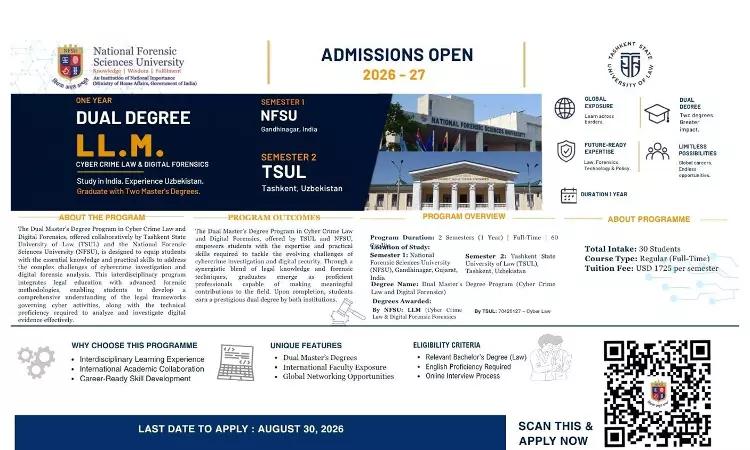
NFSU, India, in collaboration with TSUL, Uzbekistan, invites applications for the Dual Degree LL.M. in Cyber Crime Law & Digital Forensics for the academic year 2026–27. Designed for the rapidly evolving field of digital justice, the programme integrates law, technology and forensic sciences and provides academic and cultural exposure in India and Uzbekistan. It enables learners to examine the legal, investigative, evidentiary and policy dimensions of cybercrime and emerging technologies through a comparative and interdisciplinary framework.
Programme Focus
The programme focuses on Cyber Crime Law, Digital Forensics, Cybercrime Investigation, Digital Evidence, Emerging Technologies and Comparative Legal Systems. Its interdisciplinary approach is intended to help learners understand how legal principles, forensic methods and technological tools interact in contemporary investigations, adjudication, regulation and policy development.
Programme Overview
Duration: Two semesters (one year)
Course Type: Regular, full-time
Credits: 60 credits
Semester I: National Forensic Sciences University, Gandhinagar, Gujarat, India
Semester II: Tashkent State University of Law, Tashkent, Uzbekistan
Degrees Awarded: Two Master's degrees: LL.M. in Cyber Crime Law & Digital Forensics by NFSU and the corresponding Master's degree in Cyber Law by TSUL (programme code 70420127)
Total Intake: 30 students
Tuition Fee: USD 1,725 per semester
Eligibility and Selection Process
• A Bachelor's or Master's degree (Law) from a recognised or accredited institution
• Proficiency in English
• Participation in the prescribed interview process
Admission will be subject to verification of academic credentials and fulfilment of the applicable requirements prescribed by NFSU and TSUL.
Key Highlights
• Two Master's degrees awarded through two collaborating universities
• Academic and cultural exposure in India and Uzbekistan
• Interdisciplinary learning across law, technology and forensic sciences
• Engagement with global faculty and research opportunities
• Industry-oriented and policy-driven learning
• Career pathways in law firms, cybersecurity, digital investigations, government agencies and international organisations
Application Details
Last date to apply: 30 August 2026
Application form: https://forms.gle/s5whEQNBysqsMHyd7
NFSU admissions and information: https://nfsu.ac.in/news | https://nfsu.ac.in/CSAS
For any query, please write to us: admission_law@nfsu.ac.in