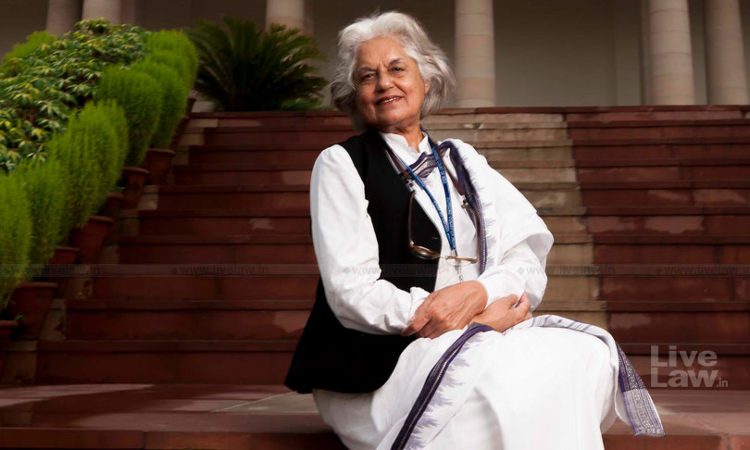
She asserted that "we must be conscious of the ideology of the person appointed" to the bench. She described the present judiciary as the 'Ideological Court'- "Some have called it the 'Executive Court'. The evidence is on the table - from the decision in the Babri Masjid case to the decision to place in cold storage the issue of the CAA, the electoral bonds and the challenge to the abrogation of Article 370, and the grant of bail to some journalists and not to others. This is a highly self-conscious court. And this is a charitable description – what we actually have is more than one Supreme Court of India, and sometimes more than one person in the personality of one judge. What we see is the policy of pick and choose, perhaps the power vested with the master of the roster" Ms. Jaising stated that a majoritarian government brings its own challenges- "Has the judiciary succumbed to the majoritarian government? Are we seeing a threatened judiciary? Will there be a repeat of ADM Jabalpur?"
So far as the appointment of judges in the US is concerned, she iterated that the transparency is of such level that every judge, before being appointed to the institution, is questioned on issues of the present times – abortion, the wall separating religion and the State, the rights of the LGBT community.
"In India, we have the worst of both the worlds – we don't have transparency, and yet we know that in the consensus that is built between the Executive and the Judiciary, the Executive has the last word...I propose an equal-opportunities manner of appointment of judges. Applications should be invited from the interested persons, putting on record their biodata. This would ensure that women, Dalits, LGBT have an equal opportunity to get appointed. Judiciary will then reflect the issues of the diverse nation, the diversity of religion, language and culture", she expressed.
She indicated the challenges which face the 'Post-COVID world'- "The pandemic has made the rich richer and the poor poorer. There are challenges of food security, the supply chain being monopolised by big businesses. These challenges will find their way into the judiciary sooner or later"
She took the audience through the various generations of lawyers since the inception of modern India, being the pool of talent from which judges are drawn - "Lawyers were very important in the pre-independence times, they were deeply engaged with the freedom struggle. They are who we called the transitional lawyers, they have travelled both from the pre-independence and post-independence world. They were the ones who were appointed as Attorney Generals and Solicitor Generals. While they were well-versed in the colonial and the common laws, they were only beginners of the regime of fundamental rights"
"Next, came the lawyers who were supported by big business houses. They were concerned basically with the challenges to the progressive land reforms, to nationalisation and to liberty. Mr. Nani Palkhivala was one of them. They experimented with challenging laws on the ground that Fundamental Rights are violated. While they served the interests of big businesses and industries and gave them a platform, they failed miserably at arguing the right to liberty in A. K. Gopalan, where it was held that if due process is complied with, the reasonableness of the law need not be gone into", continued Ms. Jaising.
She canvassed the sociological account of the bar since then – that the Bombay bar, comprising mostly Parsis and Gujaratis, has dominated development in the country and in the Supreme Court; that the Calcutta bar comprises majorly of the Bhadraloks, irrespective of their caste and creed; that the Madras bar in the pre-independence times was composed of Tamil Brahmins, and that post-independence, its character has changed in so far as confronting social justice issues is concerned. "It is this generation of lawyers which could have been role models for the future of the legal profession in this country. It is the pool of talent from which the judges are drawn. This generation can be characterised by their overt deference to power and authority and a willingness to accept whatever comes their way"
Moving on, Ms. Jaising discoursed, "Next is my generation – I called myself one of midnight's children, deeply influenced by the ideals in the values of the freedom struggle. But what was the freedom struggle? Justice D. Y. Chandrachud has defined it eloquently in the Indian Young Lawyers' Association case (Sabarimala, 2018) – 'Reading Dr Ambedkar compels us to look at the other side of the independence movement. Besides the struggle for independence from the British rule, there was another struggle going on since centuries and which still continues. That struggle has been for social emancipation. It has been the struggle for the replacement of an unequal social order. It has been a fight for undoing historical injustices and for righting fundamental wrongs with fundamental rights. The Constitution of India is the end product of both these struggles. It is the foundational document, which in text and spirit, aims at social transformation namely, the creation and preservation of an equal social order. The Constitution represents the aspirations of those, who were denied the basic ingredients of a dignified existence'" "This is what has guided my journey as a lawyer in the past 50 years. The journey in law was also inspired by the Public Interest Litigation as developed by judges like Justices P. N. Bhagwati and V. R. KrishnaIyer. Our efforts would have been nothing without them", she said.
Then she discussed the Olga Tellis case (1985), for the rights of pavement dwellers and the Bombay Hawkers' Union case (1985), both of which dealt with the rights to livelihood and dignity. She explained that it was these cases which brought to the court concerns of the "disinherited of the earth" – the hawkers, the homeless, the vegetable vendors, the rights of the self-employed, the tribals and the nomads and the women to hawk on the streets.
"But what has been the impact of opening the doors to anyone? Now one single resident of Delhi can file a PIL questioning the whole movement of farmers on the ground that he is a 'taxpayer' and hence, has the locus to stop protests of a whole community! Individual rights now have the potential to defeat collective rights. This is a very dangerous precedent. I say no more except that the voice of the generation of tax lawyers is a generation which sees its own individual convenience over all else", she expressed the view.