



Supreme court

LiveLaw Breaking News Alerts: 20/07/2026
LiveLaw is introducing a new feature —'Breaking News Alerts' — designed to keep our readers instantly updated on the most important judicial developments. With real-time coverage of urgent pronouncements and orders from the Supreme Court and High Courts, this feature ensures that critical updates reach you the moment they happen. Whether it's a landmark ruling or an urgent interim...
Employer Can't Defeat Compassionate Appointment Claim By Delaying Processing: Supreme Court
The Supreme Court has held that an employer cannot keep an employee's application for voluntary retirement on medical grounds pending until the employee crosses the prescribed age limit and then use that delay to deny compassionate appointment to the employee's dependent. The Court ruled that such an interpretation would allow an employer to "control eligibility through delayed processing"...
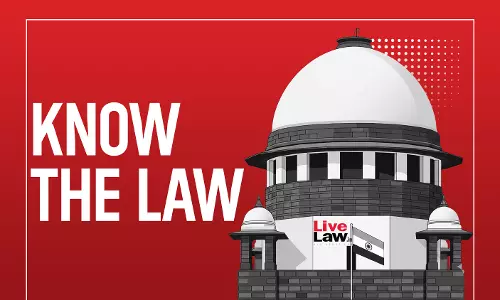
How Can Dead Witness's Testimony Be Used Against Accused Who Absconded? Supreme Court Explains S.299 CrPC
The Supreme Court has clarified that the earlier testimony of a witness who has since died can be used against an accused who had absconded during the original trial, provided the conditions under Section 299 of the Code of Criminal Procedure, 1973 (CrPC) are satisfied.A Bench of Justice Sanjay Karol and Justice Vipul M. Pancholi held that Section 299 CrPC is an exception to the general rule...
Know The Law | When Can High Courts Grant Relief Under Article 226 Beyond Pleadings? Supreme Court Explains
The Supreme Court recently clarified that although High Courts are ordinarily expected to remain confined to the pleadings and reliefs sought by parties, the rule is flexible while exercising jurisdiction under Article 226 of the Constitution. In exceptional cases, where the record clearly establishes a legal entitlement and denying relief on technical grounds would perpetuate injustice,...
Supreme Court Recommends IBC Amendment To Protect MSMEs, Says Small Operational Creditors Need Fairer Repayment Mechanism
While reaffirming the "clean slate" principle under the Insolvency and Bankruptcy Code (IBC), the Supreme Court has called upon the Law Commission and the Legislature to examine amendments to the insolvency framework to better protect Micro, Small and Medium Enterprises (MSMEs) and other small operational creditors, observing that they are significantly disadvantaged under the existing...
How To Prove A Will As Genuine? Supreme Court Explains Tests
In a significant ruling on the law governing wills, the Supreme Court has explained the principles courts must apply while determining whether a will is genuine. Reiterating settled legal principles, the Court said that although a will is proved like any other document, the law imposes additional safeguards because the maker of the will (the testator) is no longer alive to testify about...
Know The Law| When Can A Right Be Waived? Supreme Court Explains
The Supreme Court recently explained the concept of waiver of rights as an intentional relinquishment of a right, advantage, benefit, claim or privilege that the person may have enjoyed. Pertinently, the key to waiving a right is that it must first be known to the person; that is, he must be aware of his existing right. On May 13, a bench comprising Justice Dipankar Datta and Justice AG...
Know The Law | Which Documents Require Mandatory Proof Of Attestation? Supreme Court Explains
In an important ruling clarifying the scope of Section 68 of the Indian Evidence Act, the Supreme Court has explained that the statutory requirement of proving a document by examining an attesting witness applies only to documents that are required by law to be attested. A registered sale deed, the Court held, does not fall within this category and therefore need not be proved in the...
LiveLaw Supreme Court Criminal Law Digest: June 2026
Anticipatory Bail - Cancellation of - Abuse of Authority by Law Enforcers - The Supreme Court set aside the order of the High Court granting anticipatory bail to three police officers accused of extorting cash from a citizen in exchange for a gold bar recovered during a search. The anticipatory bail granted by the High Court was cancelled. When police officers, who are duty-bound to...
Art. 226 | High Courts Cannot Reweigh Evidence Or Interfere With Factual Findings In Certiorari Jurisdiction : Supreme Court
The Supreme Court has held that the Writ of Certiorari cannot be issued by the High Court to review or reweigh the evidence based on which subordinate courts decided a matter. The Court reiterated that such a jurisdiction is issued only to correct errors of jurisdiction committed by Courts or Tribunals, but not for reappreciation of evidence or acting as a Court of appeal. Holding so, a bench...