




- Home
- /
- Supreme court
- /
- Civil Courts Can Adjudicate...
Civil Courts Can Adjudicate Succession Disputes Between Non-Tribals In Scheduled Areas Of Andhra Pradesh : Supreme Court
Yash Mittal
7 Aug 2026 3:15 PM IST
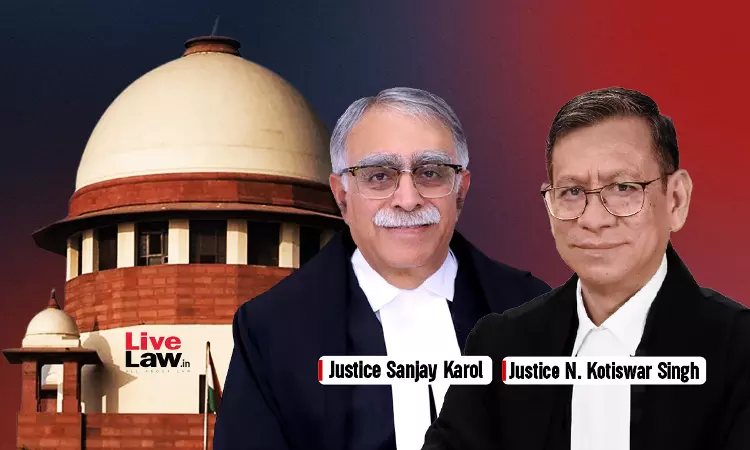
The Supreme Court on Thursday (August 6) held that the Civil Courts under the Andhra Pradesh Civil Courts Act 1972 are empowered to adjudicate the civil disputes of succession between the non-tribal parties in Schedule Areas. A bench of Justice Sanjay Karol and Justice Nongmeikapam Kotiswar Singh set aside the Telangana High Court's decision, which held the jurisdiction of the civil court...
This is a premium content
Available exclusively to
Our subscribers
Subscribe Premium 
INR 1099+GST
Your support helps us to bring you more content at
an affordable subscription scheme !!!
All payment options available
The Supreme Court on Thursday (August 6) held that the Civil Courts under the Andhra Pradesh Civil Courts Act 1972 are empowered to adjudicate the civil disputes of succession between the non-tribal parties in Schedule Areas.
A bench of Justice Sanjay Karol and Justice Nongmeikapam Kotiswar Singh set aside the Telangana High Court's decision, which held the jurisdiction of the civil court would be barred under the AP Civil Courts Act (“Act”) to adjudicate the disputes between the non-tribal parties living in the Schedule Areas.
As per the Act, the jurisdiction of the civil court is barred to adjudicate civil disputes between the tribal parties because of the non-extension of the Act to Scheduled Areas. The Court said that the Act doesn't bar the civil courts jurisdiction to adjudicate disputes between the non-tribal parties even though they are living in schedule area.
“The necessary conclusion is that the notification of Scheduled Areas is specifically directed towards the people of the Scheduled Tribes living in that area. Merely because the word 'area' has been used, it cannot be said that any and everything that falls within that geographical area pertains to scheduled tribes…there is no basis for it there to be a blanket exclusion of Civil Courts in as much as, it pertains to civil disputes of succession between exclusively non-tribal parties although the property is situated within scheduled areas. We therefore hold that the Civil Court had the requisite jurisdiction to entertain the dispute. The High Court erroneously held the Civil Court not to have jurisdiction because of the exclusion of the application of the 1972 Act to the scheduled areas. In our view, the application thereof to the parties that are not in any way connected to its purpose would be incorrect use of law.”, the Court observed.
The dispute arose out of a suit for partition and separate possession filed by members of the non-tribal family claiming rights over ancestral properties located in a Scheduled Area. While the trial court dismissed the suit, the first appellate court reversed the decision and held the properties to be joint family assets.
However, the Telangana High Court subsequently set aside the appellate court's judgment on the ground that the Civil Court lacked jurisdiction because the Andhra Pradesh Civil Courts Act, 1972 had not been extended to Scheduled Areas.
The High Court relied on the Supreme Court's earlier decision in Nagarjuna Gramin Bank v. Medi Narayana, 2004.
Aggrieved, the plaintiffs approached the Supreme Court.
Allowing the appeal, the judgment authored by Justice Karol observed that the High Court erred in relying on Nagarjuna (supra), as the said precedent nowhere discussed the exclusion of the civil courts' jurisdiction in matters pertaining to adjudication of disputes between the non-tribal parties in the Schedule Area.
“We hold that Nagarjuna supra did not lay down any proposition of law, much less to be a binding precedent.”, the Court said.
The Court stressed that the exclusion of the civil courts jurisdiction to matters between the tribal parties in the schedule areas can be understood from the constitutional aspect, to secure their customs and autonomy, however, the same cannot be used to abrogate the civil courts jurisdiction in matters between the non-tribal parties.
“When the object sought to be achieved by agency courts continuing in the Scheduled Areas is to protect the tribal people, the tribal property, their customs and practices, what is achieved by subjecting nontribal people in that area to such special procedure? There is only one answer. Nothing. Admittedly, both the parties to this dispute are non-tribals. Then, what is the rational nexus of asking them to abide by procedures not intended for them?…neither of the parties is a member of the Scheduled Tribe, nor are there any fetters of succession and partition amongst the co-sharers, it does not concur with reason to treat them as if they were members of the tribes solely on account of the land in question. The circumstances governing them cannot be called 'like circumstances'.”, the Court said.
The Court, however, clarified that “even if one party to the dispute would be a tribal residing in the Scheduled Areas, then the Agency Courts would retain the jurisdiction.”
In terms of the aforesaid, the appeal was allowed. The second appeal is restored to the file of the High Court to be decided on the merits in a manner consistent with this judgment.
Headnote
Andhra Pradesh Civil Courts Act, 1972 (Act 19 of 1972) – Sections 1(3), 2(a), 3 – Constitution of India – Fifth Schedule, Article 14, Article 244(1) – Code of Civil Procedure, 1908 – Section 9 – Scheduled Districts Act, 1874 – Andhra Pradesh Agency Rules, 1924 – Jurisdiction of Civil Courts in Scheduled Areas – Civil disputes exclusively between Non-Tribal parties - The Supreme Court held that the ordinary Civil Courts have the requisite jurisdiction under Section 9 of the Code of Civil Procedure, 1908 to entertain and adjudicate civil disputes (such as partition and succession) concerning properties located in Scheduled Areas, provided that the dispute is exclusively between non-tribal parties and involves no tribal interest or fetters - The salutary purpose and constitutional objective of establishing Scheduled Areas under the Fifth Schedule and continuing Agency Courts under the Andhra Pradesh Agency Rules, 1924 is to safeguard indigenous tribal communities, protect their lands from exploitation, and preserve their age-old customs and autonomy - Subjecting non-tribal persons to special agency procedures for disputes solely amongst themselves bears no rational nexus to the objective sought to be achieved, which is violative of Article 14 of the Constitution - Merely because a parcel of land falls within a geographically notified 'Scheduled Area', it cannot attract the blanket exclusion of Civil Courts if all parties involved are non tribals - If even one party to the dispute is a tribal residing in the Scheduled Area, the Agency Courts alone will retain jurisdiction - The restoration of Civil Court jurisdiction for disputes involving exclusively non-tribal parties applies to pending cases and those arising in the future. [Paras 10-15]
Precedent – Ratio Decidendi vs. Obiter / Judicial Deference – Inversion Test - The earlier decision in Nagarjuna Gramin Bank v. Medi Narayana did not lay down a binding proposition of law - An order passed out of judicial deference to an executive/legislative policy decision (such as the report of a High-Powered Committee of the State) without undertaking an independent legal interpretation of statutory provisions and their constitutional intent does not create a binding legal precedent - Applying the Wambaugh Inversion Test, the ratio decidendi consists strictly of the statements of the principles of law necessary for deciding the legal problem disclosed by the facts, rather than mere factual conclusions or judicial deference to executive domain. [Relied on V. Senthil Balaji v. State, (2024) 3 SCC 51; Career Institute Educational Society v. Om Shree Thakurji Educational Society, (2023) 16 SCC 458; State of Punjab v. Davinder Singh, (2025) 1 SCC 1; T.N. Medical Officers Assn. v. Union of India, (2021) 6 SCC 568; Paras 9 - 15]
Cause Title: MUKKERA VENKATA RATNAM & ORS Versus VANTASALA CHINA VENKATESWARLU & ORS.
Citation : 2026 LiveLaw (SC) 772
Click here to download judgment
Appearance:
For Petitioner(s) :Mr. Amit Pai, AOR Ms. Pankhuri Bhardwaj, Adv. Mr. Tathagata Dutta, Adv. Ms. Bhavana Duhoon, Adv. Mr. Kushal Dube, Adv.
For Respondent(s) :Mr. Vikas Bansal, AOR Ms. Devina Sehgal, AOR Mr. Srikanth Varma Mudunuru, Adv.
Tags