



- Home
- /
- Supreme court
- /
- Judgments Are Retrospective Unless...
Judgments Are Retrospective Unless Expressly Made Prospective : Supreme Court
Yash Mittal
5 Aug 2026 5:54 PM IST
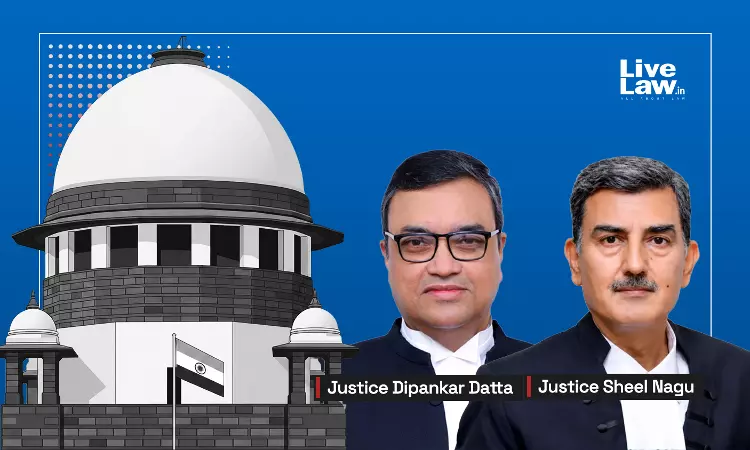
The Supreme Court has reiterated that unless its judgment expressly states that the decision would apply prospectively, it shall apply retrospectively. “If a decision of the Apex Court does not expressly provide its application to be prospective, then it is settled law that all decisions of this Court are retrospective in application…”, observed a bench of Justice Dipankar Datta...
This is a premium content
Available exclusively to
Our subscribers
Subscribe Premium 
INR 1099+GST
Your support helps us to bring you more content at
an affordable subscription scheme !!!
All payment options available
The Supreme Court has reiterated that unless its judgment expressly states that the decision would apply prospectively, it shall apply retrospectively.
“If a decision of the Apex Court does not expressly provide its application to be prospective, then it is settled law that all decisions of this Court are retrospective in application…”, observed a bench of Justice Dipankar Datta and Justice Sheel Nagu.
The bench made this observation while setting aside that part of the Karnataka High Court's judgment which had directed the Appellant, Union and State Governments to release the subvention amount for the entire 5 years even after academic year 2002-03, ignoring the fact that the scheme, which introduced the subvention amount in 1995 was declared to be unconstitutional by a 11-judge bench in TMA Pai Foundation & Ors vs. State of Karnataka, (2002) 8 SCC 481.
The controversy centered on whether the subvention scheme, introduced pursuant to interim directions of the Supreme Court, survived after the eleven-judge Constitution Bench judgment in T.M.A. Pai Foundation delivered on October 31, 2002.
The respondent institution argued that a subsequent clarificatory order directing maintenance of “status quo” indicated that the Constitution Bench decision was intended to operate prospectively, thereby preserving the scheme.
The Appellant-governments opposed the Respondent-institution's argument, arguing that the prospective protection contemplated by the Court in T.M.A. Pai Foundation related only to statutory provisions that were inconsistent with the law declared by the Constitution Bench and required legislative or regulatory modification.
The Single and Division Bench of the High Court allowed the Writ Petition of the Respondent-institutes, directing the payment of the subvention amount for the entire five years to the students who were admitted latest in the academic year 2002-03 for a period of 5 years. Further, acknowledging the eleven-judge bench decision in 2002 discontinuing the subvention scheme, the High Court held that the institute would not be entitled to the subvention amount in respect of students admitted in the academic year 2003-04.
Against the High Court's judgment, the Union and State governments moved to the Supreme Court.
Setting aside the impugned judgment, the judgment authored by Justice Nagu observed that the High Court fell in error in extending the scope and ambit of the subvention scheme, despite the same being declared to be unconstitutional in 2002 by an eleven-judge bench.
The Court rejected the Respondent-institute's argument about the prospective operation of the eleven-judge decision, noting that if the judgment intended to so it would have expressly mentioned the prospective operation of the judgment. Since the judgment does not expressly mention its prospective operation, the judgment would be retrospective in operation, rendering the subvention scheme to be unconstitutional from the date of its inception, the Court said.
"...the schemes or executive instructions, particularly the subvention scheme, died its own death on 31.10.2002 when the scheme was declared unconstitutional by the final decision in TMA Pai Foundation (supra) case by 11-Judge Bench.", the Court observed.
Thus, the High Court's direction to the Appellant to extend the benefit of the subvention scheme to the students for five years, who were admitted in the academic year of 2002-03 was set aside, however, the direction with respect to non-extension of the benefit to the students who were admitted in 2003-04 was upheld.
“…it was not incumbent upon the Central Government to pay the subvention amount for the entire 5- year course in one go and therefore, the Single Bench and the Division Bench of the High Court of Karnataka were incorrect in directing release of the subvention amount for the entire 5 years even after academic year 2002-03. Such a course was impermissible once the subvention scheme was declared unconstitutional on 31.10.2002 (TMA Pai 11 Judge Bench decision).”, the Court observed.
In terms of the aforesaid, the appeal was partly allowed.
Headnote
Constitution of India — Article 141 — Retrospective operation of Supreme Court judgments — Declaration of Law — Subvention Scheme — Stoppage of subvention post-unconstitutionality of the Unni Krishnan scheme – Held - Unless a decision of the Supreme Court explicitly declares its application to be prospective, the law declared by the Court carries a retrospective effect - The subvention scheme formulated via interim orders during the pendency of the TMA Pai Foundation case ceased to exist on October 31, 2002, when the 11-Judge Bench declared the Unni Krishnan scheme unconstitutional - The subvention scheme obligated the Central Government to pay the subvention amount on an annual basis rather than as a lump sum for the entire course; hence, there existed no vested right for educational institutions to claim subvention amounts for the entire 5-year duration of a course for students admitted during or prior to the 2002–03 academic year once the scheme itself was declared unconstitutional. [Paras 10 - 12]
Writ Jurisdiction — Article 226 of the Constitution of India — Pleadings and Proof — Distinction between Civil Procedure Code and Writ Petitions — Abstract questions of law requiring factual substantiation - Held: When an issue such as shortfalls in revenue vs. expenditure or claims of financial hardship ostensibly presents a point of law that must be substantiated by facts, the party asserting it in a writ petition must plead and prove such facts through evidence annexed directly to the writ petition or counter-affidavit - Unlike pleadings under the Code of Civil Procedure where only material facts are required to be pleaded, a writ petition or counter-affidavit must contain both facts and the evidence in proof thereof - In the absence of specific pleadings or proof showing that revenue generated fell short of expenses incurred, the Court will not entertain such claims. [Relied on P.V. George v. State of Kerala, (2007) 3 SCC 557; Bharat Singh and Others v. State of Haryana and Others, (1988) 4 SCC 534; Paras 6-13]
Cause Title: GOVERNMENT OF INDIA & ANR. VS. SRI DEVRAJ URS MEDICAL COLLEGE (with connected case)
Citation : 2026 LiveLaw (SC) 766
Click here to download judgment
Appearance:
For Appellant(s) : Mr. Brijender Chahar, A.S.G. Ms. Madhulika Upadhyay, AOR Ms. Rekha Pandey, Adv. Mr. Rohitash Singh Nagar, Adv. Mr. A Deb Kumar, Adv. Ms. Sunita Sharma, Adv. Ms. Neelakshi Bhadauria, Adv. Mr. Raj Bahadur Yadav, AOR
For Respondent(s) : Mr. Mahesh Thakur, Adv. Mr. Siddhartha Sati, Adv. Mr. Narveer Yadava, Adv. Ms. Ayushi Srivastava, Adv. Mr. Sandiv Kalia, Adv. Dr. Sushil Balwada, AOR
Tags