


3 Year Practice Rule : Live Updates From Supreme Court Verdict
LIVELAW NEWS NETWORK
21 Aug 2026 6:48 AM IST
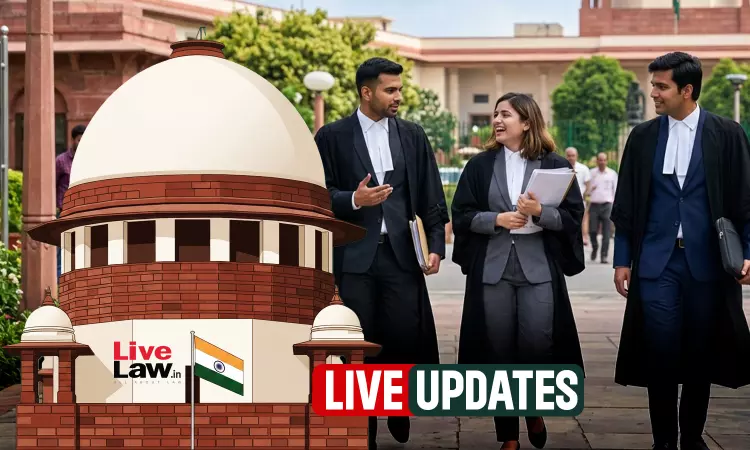
The Supreme Court will pronounce its verdict today on a batch of review petitions challenging its earlier judgment which made three years of legal practice mandatory for candidates seeking entry into the judicial service through direct recruitment as Civil Judges (Junior Division).
A Bench comprising Chief Justice of India Surya Kant, Justice August George Masih and Justice K Vinod Chandran will pronounce the verdict at 10.30 AM today.
As per the causelist, the judgment is to be pronounced by Justice Chandran.
The review petitions seek reconsideration of the Court's May 2025 decision restoring the three-year practice requirement for entry-level judicial officers, contending that the mandate may discourage meritorious law graduates from joining the judiciary immediately after graduation.
The Court also heard a writ petition seeking the relaxation of the 3-year rule for persons with disabilities.
Follow this page for live-updates from the verdict pronouncement.
Live Updates
- 21 Aug 2026 11:23 AM IST
Key takeaways from #SupremeCourt's review verdict on 3-year practice rule.
1. Practice condition waived for judicial service exam notifications from May 20, 2025 till March 31, 2027.
2. But such candidates, upon selection, will be appointed as trainee judges and undergo training at the Judicial Academy for one year.
3. After training, they must undergo one year clerkship. 6 months under District Judge and 6 months under High Court Judge.
For judicial service exam notifications after April 1, 2027.
1. Candidates must have one year law practice.
2. Post-selection, they must undergo 1 year training and 1 year clerkship (6 months under District Judge + 6 months under HC Judge).
CJI Surya Kant and Justice AG Masih were in the majority. Justice Vinod Chandran dissented and dismissed the review petitions.
- 21 Aug 2026 10:59 AM IST
CJI: After the transition period, it is 1 year of active practice is required. Thereafter the selected candidates shall undergo aforementioned 1 year training at the state judicial academy and 1 year of law club.
The scheme is not immutable. The effect of the present arrangement can be assessed only after it has operated for a reasonable period. A period of 3 years provides sufficient institutional experience to evaluate whether the scheme is achieving the desired objective. The court may thereafter revisit the scheme based on relevant indicators.
- 21 Aug 2026 10:51 AM IST
CJI: after the transition period candidates seeking appointment as civil judge junior division shall posses at least one year of active practice, subject to verification of certificate of practice.
Notifications to be issued hereafter for recruitment have to be in conformity with the force a directions. High courts to modify the relevant Rules governing the cadre of judicial service in conformity with these directions within 3 months.
This directions also adequately address the issues raised in with respect to the need for accommodation for persons with disability.
- 21 Aug 2026 10:50 AM IST
CJI: after completion of 1 year at the state judicial academy the training judge will go further 1 year of law clerkship. First six months under a principal district judge and the remaining 6 months under sitting judges of the High Court.
During the trainee period at SJA the trainees will get emoluments equal to half of the gross remuneration to a judicial magistrate first class.
During the clerkship they will get emolument payable during training at the state judicial academy.
- 21 Aug 2026 10:41 AM IST
CJI: judgement under review does not require reconsideration on the desirability of practical experience but limited intervention is required in the manner in which the requirement is implemented. The objective behind the rule can be achieved not just through conventional practice but through a combination of pre institutional training at the state judicial academy and supervised probation which will be treated as equivalent to practice at the bar for the purpose of eligibility.