




- Home
- /
- Top Stories
- /
- Solid Waste Management Rules 2026 :...
Solid Waste Management Rules 2026 : Supreme Court Directs Centre To Frame Guidelines On Environmental Compensation
LIVELAW NEWS NETWORK
4 Aug 2026 7:31 PM IST
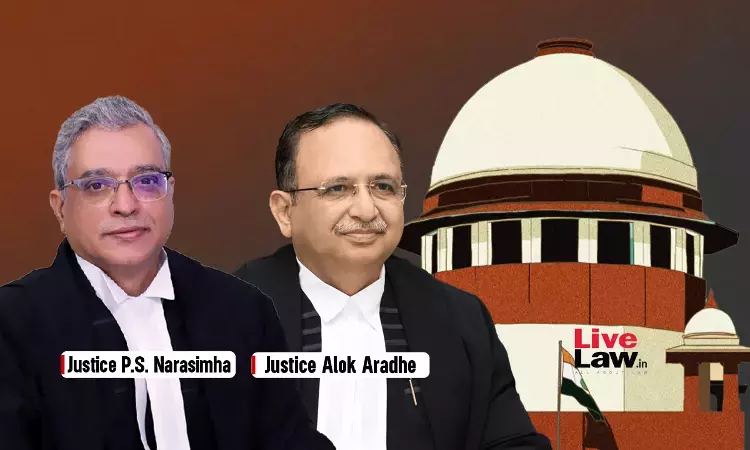
The Court's judgment laid down certain principles for the Centre to follow.
The Supreme Court on Tuesday laid down a comprehensive set of principles to guide the determination of environmental compensation under the Solid Waste Management Rules, 2026, while directing the Ministry of Environment, Forest and Climate Change (MoEF&CC) to formulate detailed guidelines for imposing and collecting such compensation.A Bench of Justice Pamidighantam Sri Narasimha and...
This is a premium content
Available exclusively to
Our subscribers
Subscribe Premium 
INR 1099+GST
Your support helps us to bring you more content at
an affordable subscription scheme !!!
All payment options available
The Supreme Court on Tuesday laid down a comprehensive set of principles to guide the determination of environmental compensation under the Solid Waste Management Rules, 2026, while directing the Ministry of Environment, Forest and Climate Change (MoEF&CC) to formulate detailed guidelines for imposing and collecting such compensation.
A Bench of Justice Pamidighantam Sri Narasimha and Justice Alok Aradhe passed the directions while hearing appeals concerning solid waste management. The Court said that with the notification of the Solid Waste Management Rules, 2026, the focus must now shift from merely framing laws to ensuring their effective implementation through robust institutional mechanisms.
"Our endeavour is to institutionalise the process of solid waste management for our country," the Bench observed, adding that constitutional courts and the National Green Tribunal have a continuing duty to ensure that statutory mandates are translated into an effective enforcement system.
The Court noted that, pursuant to its earlier order dated May 12, 2026, the Centre had constituted the Central Implementation Committee under Rule 18 of the Solid Waste Management Rules, 2026 through an Office Memorandum dated March 9, 2026. Appreciating the prompt action taken by the Ministry, the Court observed that the Committee would play a central role in monitoring implementation of the Rules, supervising the online centralised portal, recommending measures to the Ministry, and preparing guidelines for the imposition and collection of environmental compensation.
The Bench emphasised that environmental compensation should not be left to the unguided discretion of regulatory authorities or courts.
"It is high time that the determination and imposition of environmental compensation is not left to the discretion of regulatory bodies, tribunals, or Courts. There must be a structured regime through which people will know with clarity and certainty, as to, for which type of environmental violation, what consequential punitive action will follow," the Court observed.
To assist the Central Implementation Committee, the Court distilled the governing principles for assessing environmental compensation from precedents such as MC Mehta.
Among the principles laid down are:
I) Environmental compensation cannot be seen as a replacement for penalties levied against the erring polluter. It is restitutionary in nature and is paid in addition to the penalty or fine that the polluter is liable to pay.
II) The temporal extent of paying compensation by the polluter ends only when the damage caused is reversed.
III) The appropriate authorities of the State have a duty to undertake an exercise of valuing the damage caused by the polluter and collect such compensation required for restoration of the environment.
IV) While determining the amount of environmental compensation, both tangible and intangible damage caused by the polluter must be considered.
V) Even if actual harm is not caused but is imminent or the actions/activities of the polluter have the potential to cause harm, the liability to pay compensation will come into place.
VI) Factors such as the financial capacity of the polluter, the cost involved in assessing the damage and loss suffered by individuals and the environment as well as the cost of remediation or restoration are also to be taken into account while valuing such compensation.
VII) Any environmental compensation levied must be proportional to the damage caused by the polluter and must have some rational nexus to the pollution caused.
VIII) All courts and tribunals must record reasons while determining environmental compensation, listing the factors considered, the valuation standard used to assess such damages and the formula or guidelines applied to quantify the compensation payable.
The Court further observed that the Central Implementation Committee could draw guidance from existing regulatory frameworks, including the Plastic Waste Management Rules, Hazardous Waste Management Rules and the Environment Protection (Manner of Holding Inquiry and Imposition of Penalty) Rules, 2024, which already prescribe structured methodologies for determining environmental compensation.
Accordingly, the Bench directed the MoEF&CC to formulate guidelines under Rule 17(2) of the Solid Waste Management Rules, 2026 after taking into account the principles laid down by the Court as well as existing regulatory frameworks governing environmental compensation.
The Ministry has been directed to file an affidavit placing on record the progress made in framing and issuing the guidelines. The matter will next be heard on September 29, 2026.
Headnote
Solid Waste Management Rules, 2026 — Rule 16, Rule 17, Rule 18, Rule 38(3) — Environmental Governance — Institutionalisation of Regulatory Bodies — Determination and Imposition of Environmental Compensation — Essential Principles - Institutionalisation of Environmental Regulatory Bodies - Constitutional Courts and the National Green Tribunal have a legal duty to ensure that statutory mandates and rules are translated into effective enforcement systems - The Supreme Court emphasized that establishing regulatory bodies requires ensuring their formal notification, appointment of members, provision of infrastructure and human resources, and clear definition of powers accompanied by accountability - Constitutional Courts must provide necessary hand-holding to enable regulatory bodies to function with discipline, efficiency, integrity, and fairness, thereby moving away from micromanaging environmental governance while earning public trust.
Central Implementation Committee & Force of Law - The Central Implementation Committee constituted by the Central Pollution Control Board (CPCB) pursuant to Rule 18 read with Rule 38(3) of the Solid Waste Management Rules, 2026, is the duty bearer for monitoring and implementing the SWM Rules. Its functioning, orders, and decisions carry the full force of law - Determining environmental compensation under Rule 17 must follow a structured, objective regime based on clarity, certainty, and deterrence rather than unguided discretion - Synthesizing historical and recent legal precedents, the Supreme Court formulated eight essential governing principles – Held that - i. Restitutionary Nature: Environmental compensation is restitutionary in nature to restore ecological damage and is levied in addition to (not as a replacement for) statutory penalties or fines – ii. Temporal Extent: The duty of a polluter to pay compensation continues until the environmental damage caused is fully reversed; iii. Duty of Authorities: State authorities are obligated to undertake valuation of environmental damage and recover compensation required for complete restoration; iv. Tangible & Intangible Harm: Valuation must encompass both direct/tangible costs and indirect/intangible ecological damages; v. Potential Harm Liability: Compensation liability attaches even where actual damage is imminent or where activities pose a potential threat of environmental harm; vi. Financial Capacity & Remediation Cost: Factors such as the financial capacity/prosperity of the enterprise, costs incurred in assessing damage, loss suffered by individuals, and overall restoration costs must guide valuation; vii. Proportionality & Rational Nexus: Compensation levied must strictly be proportional to the damage caused and bear a rational nexus to the specific pollution - All Courts, Tribunals, and Adjudicating Authorities must record explicit reasons detailing the factors considered, standard of valuation used, and formula applied to quantify compensation. [Paras 15-24]
Case : Amravati Municipal Corporation v Ganesh Dadarao Anasane and others
Citation : 2026 LiveLaw (SC) 760
Tags