SG: "Your lordships would test if a particular subject, that particular matter, not the entry, can ever be within the domain of the union territory or not, as opposed to federating states. Union territories are an extension of the union government by definition and even constitutionally. The very purpose of creating a graphical area as the union territory by itself suggests that the union itself wants to administer the territory, meaning thereby through its own offices. So all union territories are administered by Central civil services officers and all central government officers"
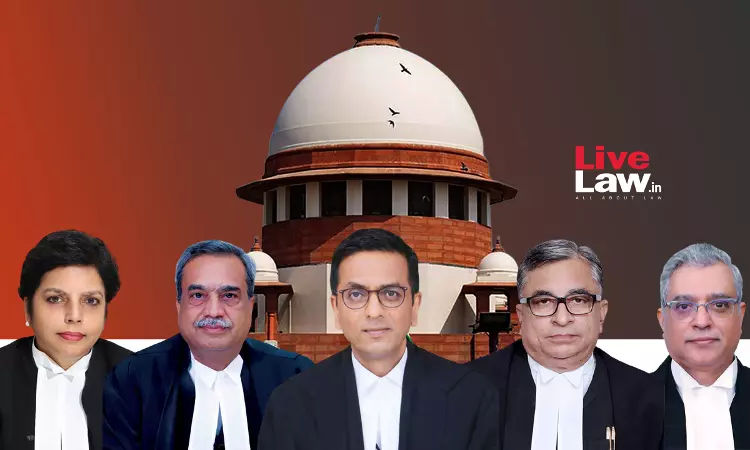
Justice Chandrachud: "Then what is the purpose of having an elected government in Delhi at all if the administration is to be carried out only at the beck and call of the central government?"
SG: "Let me distinguish two things, then everything will fall into place- The functions of the officers, and the administrative or disciplinary control of the officers. When a central services officer or danics officer or IAS officer is posted at Dadra and Nagar Haveli as a commissioner under the obligation of issuing licences, then he will be guided by the policies of the state government, he will be governed by the transaction of business rules, he will be answerable to Minister, Minister will formulate policy of how to give licence and how not to give licence, what are the parameters to be considered, how the ministry will run, the functional control will be of the elected Minister. We are concerned with administrative control, who posts, who appoints, who departmentally proceeds, who transfers. But that officer cannot ask the Home Secretary whether I should give licence or not, for that he will have to report to the ministers. There are two different things- functional control is obviously with the minister concerned"
Justice Chandrachud: "Suppose the officer is not properly discharging functions. See how anomalous this will be. If the officer is not discharging his functional role properly, the Delhi government will have no role to say we will send this person and get somebody else. Where will they be? Can we say they will have no jurisdiction over authority in respect of where he will be posted, whether he should be in education or elsewhere?"
SG: "Suppose the Central government sends a person as Secretary, Environment. Delhi is the capital of the country. You have neighbouring states. Maybe as per the policy of the Delhi government or irrespective of the policy, he starts having a non-cooperation with some secretary dealing with a similar department in Punjab and Haryana, Rajasthan or UP continuously. Suppose, the Haryana home secretary is dealing with terrorism and this man never cooperates. Would it not be necessary for the state government to say that you remain there but you are shifted to health? Suppose the health secretary, maybe as per the policy of the government or as per his own will, starts acting in a manner that there is an epidemic, and some actions are not taken for some reason, which might have an all India repercussion. The state government must retain its control. And if there is a bona fide reason that this officer is not suitable for the post, this officer has committed misconduct, then the disciplinary authority is, undisputedly as per law, the Ministry of home affairs. You just intimate the LG that please transfer this officer and the LG is under the obligation to forward it to the cadre controlling authority. This is how the scheme has worked so far. I have a list that whenever there was a request from the minister that either appoint someone or bring in someone else from somewhere to my department or transfer someone, LG has intimated in writing and the necessary actions are taken. But as per the constitutional provision, that power is retained by the central government, by LG as a representative of the President of India because you’re administering the capital of the country. I am not in functional control"
Justice Narasimha: "Once the allocation is made to a particular state or union territory, the IAS cadre rules say the posting is to be left to the state. Dr Singhvi, on the other hand, also said that the posting will vest in the state but the union would continue to have the disciplinary authority. In IAS, we know invariably that the cadre controlling authority is always the union because DOPT will control that with regard to postings, assignments. Tell us the distinction between state and Union territory and the distinction between GNCTD and the union territory?"
Justice Kohli: "how are you doing it in other union territories?"
SG: "Through administrator. In Delhi, only the nomenclature of the administrator is LG. It is not a governor in that sense"
SG: "All India service officers are appointed under the all India services act. Once I clear the examination I can choose my cadre. Depending on my ranking, I get the cadre. All our state carders. Except for AGMUT cadre. AGMUT cadre includes Arunachal Pradesh, Goa, Mizoram, Andaman and Nicobar, Chandigarh, Daman and Diu, Dadra Nagar Haveli, Lakshadweep, Puducherry, Ladakh, Jammu and Kashmir, Delhi. If I am given AGMUT cadre, I can be transferred to any one of these only. There is no separate cadre union territory-wise. So far as Delhi administration is concerned, there are three tiers- 1st is all India services, second is DANICS, The third year is Delhi administration subordinate service. That is group C and D services. The appointment to the 1st 2 tiers is made by the UPSC. So far as the third is concerned, central government has created a service selection board"
SG: "The submission is that the very same amendment, that is, the seventh amendment which introduces union territories and which introduces the administrator for union territories, amends article 315 to include only the governor, meaning thereby that here, 'state' means 'state' and not 'union territories'. So there can be no Public service commission for a union territory, it was not contemplated. In 316, there is no provision for an administrator appointing the chairman of any such commission either. Then, there is 308 also. Reading them together, there are only state services and State Public service commission. If I can satisfy your lordships that there can be no Public service commission for UT, then contextually, the subject of services also is out because your lordships would not bifurcate it.
There are only two services contemplated under part 14-union services and state services. For union territories, the union services go and serve. There is no third category"
Justice Shah: "Otherwise union territory would be equated with state"