



- Home
- /
- Top Stories
- /
- How Regionally Representative Is...
How Regionally Representative Is Supreme Court? Delhi, UP Leads The List, North-Eastern States Barring Assam Unrepresented
Awstika Das
8 Feb 2023 10:03 AM IST
Amidst the protracted power struggle between the centre and the Supreme Court over judicial appointments, last week, the government notified the elevation to the top court, of five chief justices and puisne judges of high courts, whose names had been cleared by the collegium in December. On Monday, Justices Pankaj Mithal, Sanjay Karol, P.V. Sanjay Kumar, Ahsanuddin Amanullah, and Manoj...
This is a premium content
Available exclusively to
Our subscribers
Subscribe Premium 
INR 1099+GST
Your support helps us to bring you more content at
an affordable subscription scheme !!!
All payment options available
Amidst the protracted power struggle between the centre and the Supreme Court over judicial appointments, last week, the government notified the elevation to the top court, of five chief justices and puisne judges of high courts, whose names had been cleared by the collegium in December. On Monday, Justices Pankaj Mithal, Sanjay Karol, P.V. Sanjay Kumar, Ahsanuddin Amanullah, and Manoj Misra took oath as judges of the apex court. We take a look at how well the states and union territories of India are represented in the highest court of the land.
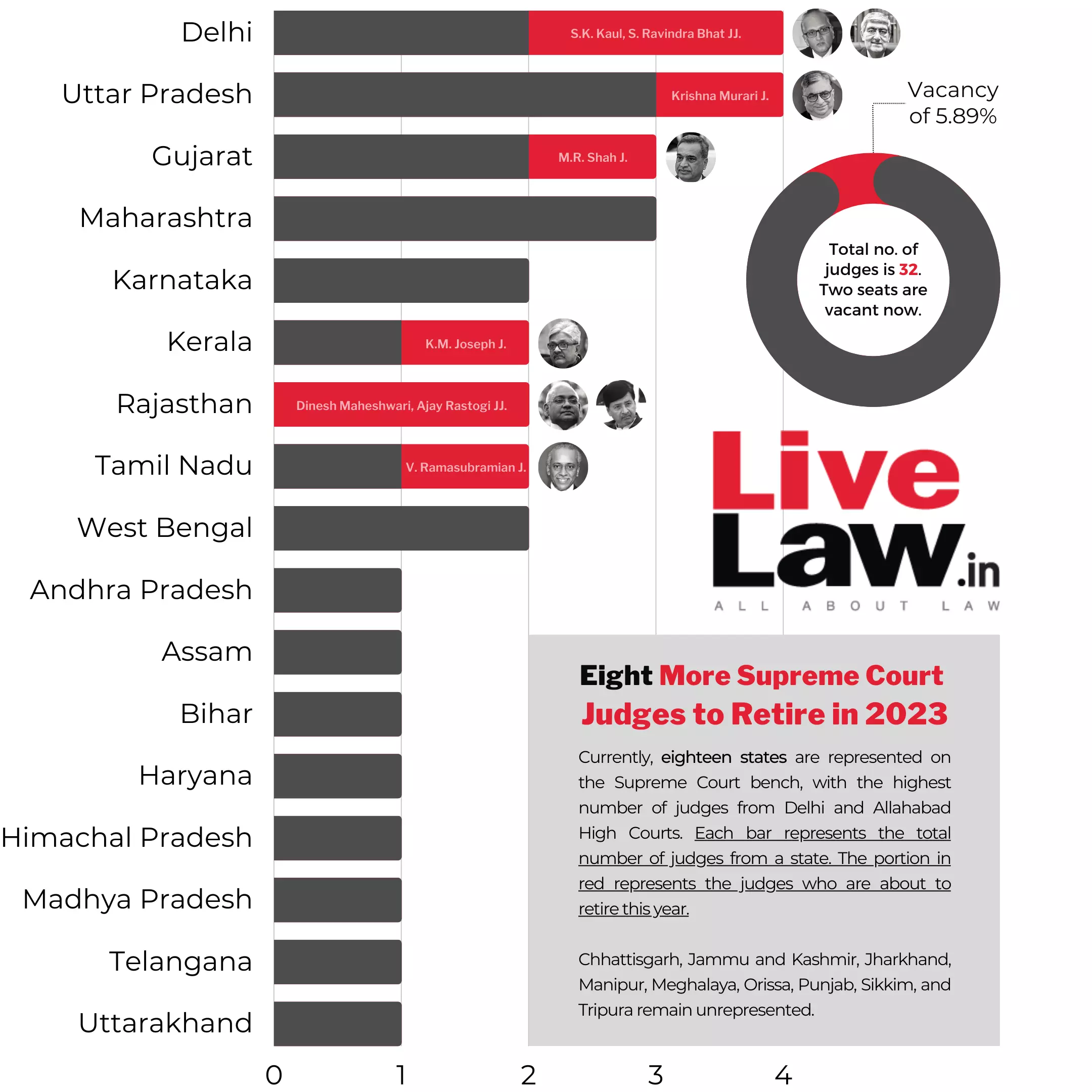
| State/UT | Judges |
| Delhi | Justices SK Kaul, S Ravindra Bhat, Sanjiv Khanna & Hima Kohli |
| Uttar Pradesh | Justices Krishna Murari, Vikram Nath, Pankaj Mithal and Manoj Misra |
| Gujarat | Justices MR Shah, Bela Trivedi and JB Pardiwala |
| Maharashtra | Chief Justice DY Chandrachud, Justices BR Gavai and Abhay S Oka |
| Karnataka | Justices AS Bopanna and BV Nagarathna |
| Kerala | Justices KM Joseph and CT Ravikumar |
| Rajasthan | Justices Dinesh Maheshwari and Ajay Rastogi |
| Tamil Nadu | Justices V Ramasubramanian and MM Sundresh |
| West Bengal | Justice Aniruddha Bose &Justice Dipankar Datta |
| Andhra Pradesh | Justice PS Narasimha |
| Assam | Justice Hrishikesh Roy |
| Bihar | Justice Ahsanuddin Amanullah |
| Haryana | Justice Surya Kant |
| Himachal Pradesh | Justice Sanjay Karol |
| Madhya Pradesh | Justice JK Maheshwari |
| Telangana | Justice PV Sanjay Kumar |
| Uttarakhand | Justice Sudhanshu Dhulia |
With the latest appointments, the working strength of the Supreme Court has increased from 27 to 32, against a sanctioned strength of 34 judges. However, at the time of the Constitution coming into force, the Supreme Court, which was envisaged to be the successor of the Federal Court but with wider powers, had only eight judges. It was left to the Parliament to increase this number. Speaking at the first foundation day celebration organised by the top court, Chief Justice D.Y. Chandrachud, on Saturday, took the audience on a stroll down memory lane. “The court's workload during the initial years was a fraction of what we witnessed today. Justice B.P. Singh recounted that when he visited the Supreme Court for the first time in 1956, the proceedings were solemn and virtually dull. At a time, only five to six lawyers would be present in the court hall. Over the years, the workload of the Supreme Court has increased and with it, the sanctioned strength of the court. Currently, it stands at 34 judges. In the early years, all the judges would sit together to hear the cases. But, as the number of cases increased, the court started sitting in smaller benches of two and three judges.”
The number of judges was increased by the Parliament from eight to 11 in 1956, 14 in 1960, 18 in 1978, 26 in 1986, 31 in 2009, and finally, to 34 in 2019. Currently, the Supreme Court comprises the chief justice and 31 puisne judges, with the two remaining seats likely to be filled in the coming days if the centre accepts the collegium’s January 31 proposal to appoint the chief justices of the Allahabad and Gujarat High Courts, Justices Rajesh Bindal and Aravind Kumar, respectively, as Supreme Court judges.
Awstika Das
Awstika Das, an alumna of the Faculty of Law at the University of Delhi, and the Department of International Relations at Jadavpur University, is a Delhi-based lawyer and a multimedia journalist. She works as a special correspondent covering the Indian Supreme Court. She also hosts a weekly legal news round-up segment on YouTube.