



Rajasthan High Court
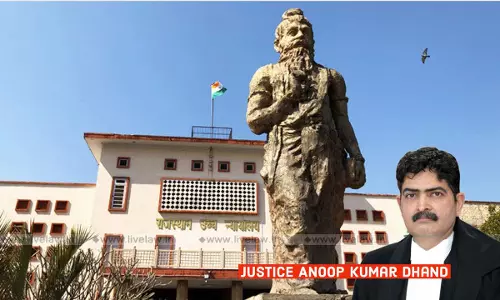
Deceased Victim's Legal Heirs Fall Under Ambit Of Section 2(wa) CrPC, Entitled To Continue Appeal Against Acquittal: Rajasthan High Court
Rajasthan High Court has held that legal representatives/heirs of the victim fall under the ambit of the term “victim” under Section 2(wa) CrPC, and thus have the right to continue prosecution against the accused in the event of the victim's death.The bench of Justice Anoop Kumar Dhand further observed that while many amendments were made in favour of the victim, giving them right to...
Rajasthan High Court Asks Centre, State To Inform On Formulation Of SOP On Recall Of LOCs After Bail To Accused Who Seeks To Travel Abroad
Rajasthan High Court has sought assistance of the Additional Solicitor General and Advocate General to apprise the Court on steps taken for the formulation Standard Operating Procedure (SOP) for timely intimation to authorities about grant of bail to accused persons against whom an LOC was issued, so that it can be recalled. The bench of Justice Anoop Kumar Dhand has also sought clarity on...
Civil Services Candidates Require Impeccable Character; Acquittal On Benefit Of Doubt Not Automatic Clean Chit: Rajasthan High Court
The Rajasthan High Court upheld the rejection of petitioner's candidature for Rajasthan State and Subordinate Services, in light of 2 (two) criminal cases against her alleging extortion after impersonating as public servant, that resulted in acquittal based on benefit of doubt. While agreeing that a person could not be denied public employment only on the ground of pending petty criminal case...
SC/ST Act | Cognizance, Charge-Framing Orders Are Appealable U/S 14A, Can't Be Challenged Directly U/S 482 CrPC: Rajasthan HC
The Rajasthan High Court dismissed a petition challenging order of cognizance and framing charges under the SC/ST Act, 1989 (“the Act”) opining that these orders were appealable under Section 14A of the Act. The bench of Justice Anoop Kumar Dhand held that the order of taking cognizance and order of framing charges were not interlocutory in nature, and as per Section 14A of the Act, an...
Wife Continuing Dowry Case After Taking ₹20 Lakh Alimony & Mutual Divorce Is Abuse Of Law: Rajasthan High Court
The Rajasthan High Court held that continuation of proceedings against ex-husband and his family by the ex-wife even after receiving a lumpsum amount of Rs. 20 lakhs as alimony and procuring a decree of mutual divorce, amounted to abuse of the process of law. The bench of Justice Anoop Kumar Dhand observed that the matter indicated a reverse trend wherein the complainant-wife, despite...
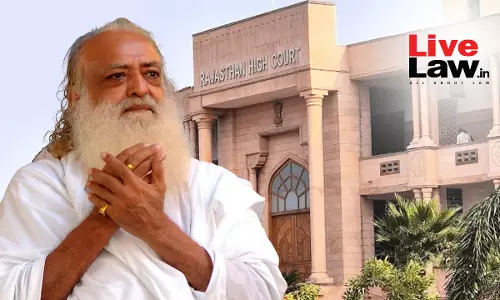
Rajasthan HC Permits Medical Care To Asaram In Jail Granted In Earlier Orders; Rejects Plea For Temperature-Controlled Ward, Pvt Ambulance
Rajasthan High Court has directed that all the facilities, accommodations, permissions and medical arrangements that were made available to the rape convict, Asaram, by the earlier orders of high court and Supreme Court, shall continue to remain operative in the same manner, after his appeal against conviction was dismissed by court.Asaram had moved the high court seeking restoration of...

Rajasthan High Court Passes Standing Order Directing Reflection Of Adjournments In Each Case In Cause List
The Rajasthan High Court has passed a standing order on June 10 directing that from now onwards, the number of adjournments taken in a particular matter shall be separately reflected in the cause list along with the case code. The Standing Order No. 06/S.O/2026, mentioned that such count of adjournments shall be maintained through a software/application developed for this purpose, such that it...
Court Does Not Become 'Functus Officio' After Directing Probe Under S.156(3) CrPC, Must Call For Progress Reports: Rajasthan High Court
Rajasthan High Court held that once the direction for investigation was issued by the Criminal Court in terms of Section 156(3), CrPC, it does not become functus officio, but remained under an obligation to call for progress reports in case it found that the investigation was not completed within a reasonable time. The bench of Justice Rekha Borana observed that the Court had noticed many...
State Cannot Profit From Its Own Failure To Maintain Service Records: Rajasthan High Court Orders Release Of Retiral Dues, ₹50K Cost
The Rajasthan High Court slammed the State for non-release of pensionary dues to the petitioner who retired in 2023, on account of non-completion of the service book, terming it as “inexcusable administrative inaction”.The bench of Justice Arun Monga observed that the service book had to be maintained and updated by the employer i.e. the State. Hence, it was manifestly unjust to allow...
Contractual Employees Can't Be Replaced By Another Set Of Contractual Employees: Rajasthan High Court Grants Relief To Vocational Trainers
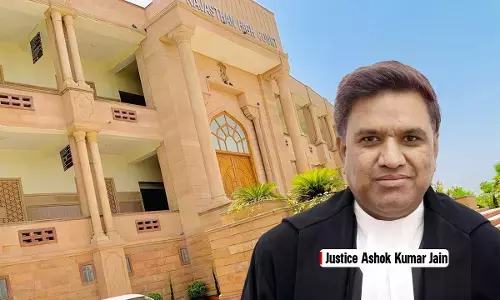
Rajasthan High Court granted relief to the petitioners who were serving as vocational trainers for several years, and were deployed through third party agencies i.e. vocational training providers (VTPs). The services of the petitioners were terminated after the State terminated the contract with the VTPs. The bench of Justice Ashok Kumar Jain directed the State to engage the petitioners...
Terms In Past Advertisement Does Not Create Vested Right For Candidates To Insist On Same In Future Public Recruitment: Rajasthan High Court
Rajasthan High Court held that inclusion of a particular condition in past year's advertisement for public recruitment did not create any vested right in favour of candidate to insist upon identical conditions in the future recruitments too. The bench of Justice Anand Sharma observed that every recruitment process was an independent exercise and the employer was competent to modify or...
Candidate Deprived Of Public Employment Over Lodging Of FIR Despite Negative Final Report Violates Article 14: Rajasthan High Court
Rajasthan High Court held that depriving a candidate of public employment merely due to registration of FIR that resulted in negative report, was not only arbitrary but also punished a candidate for no fault of his. The bench of Justice Arun Monga observed that such a proposition placed a citizen's career at the mercy of someone who chose to file a false complaint. “The mere registration of...